In today’s fast-growing markets for apparel customization, streetwear merchandise, and e-commerce printing, DTF and DTG have become two of the most commonly compared digital printing solutions. At first glance, many people think both can print patterns and both can be used on T-shirts, but once they enter actual production, they quickly realize that the two differ greatly in workflow logic, fabric compatibility, cost structure, and finished product performance. Choosing the right technology does not just affect print quality—it directly impacts the range of orders you can take, delivery speed, and profit margins.
Differences in Printing Principles and Production Workflow
To understand why these two technologies suit different production scenarios, it is necessary to first understand their underlying logic.
DTF Transfers First, DTG Prints Directly
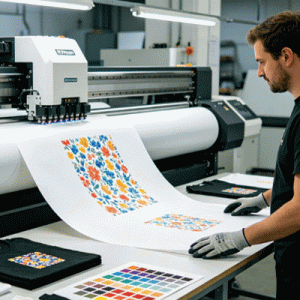
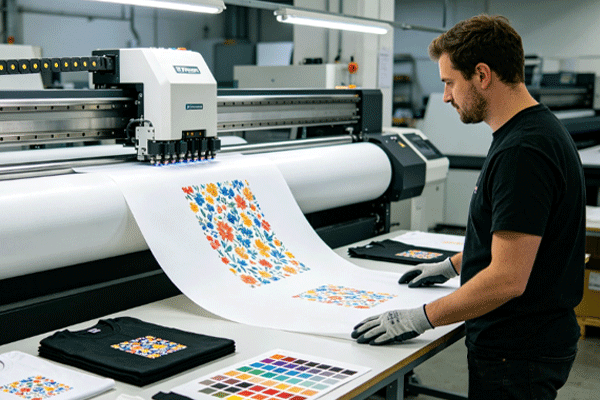
The core of DTF is “print on film first, then transfer to the garment,” while DTG means “spray ink directly onto the fabric surface.” This is the most fundamental difference between the two.
- DTF requires PET film as an intermediate carrier. The design is first formed on the film and then transferred to the finished product through heat pressing, making the entire process more like a complete transfer system.
- DTG eliminates the transfer step. The printhead directly faces the garment surface to complete the image, giving it an advantage in single-piece direct output and instant production.
- DTF is better suited for centralized production and parallel processing of multiple orders, because the front end can print in batches and the back end can transfer uniformly, making production scheduling easier.
- DTG is better suited for single-piece direct output and high-precision imaging, because it reduces intermediate steps, but it also requires higher standards for fabric condition and pretreatment.
This difference in workflow determines that the two machines serve completely different application scenarios and play different roles in a factory.
Different Workflow Complexity and Operating Logic
From a production-step perspective, DTF is more like a complete transfer chain, while DTG is more like a direct imaging device. Their operating logic is not the same.
- DTF usually includes multiple steps such as printing, powdering, drying, and heat pressing. Each step must connect smoothly to ensure the final pattern adheres firmly and the colors remain vivid.
- DTG usually only requires pretreatment and printing. The workflow is shorter and more direct, making it more efficient for small-batch, single-piece production.
- DTF has more steps but stronger adaptability, because it can standardize the output of the design first and then transfer it uniformly to different garments.
- DTG has a shorter workflow but higher fabric requirements. Especially on dark garments and highly absorbent fabrics, whether pretreatment is done properly directly affects the final quality.
If a business values flexible order handling, DTF is more user-friendly; if it values direct output, DTG is simpler. However, the two production logics cannot simply replace each other.
Differences in Fabric Compatibility and Order Range
Fabric compatibility often determines what kinds of orders a machine can handle, and therefore defines the business boundaries of a factory.
DTF Has a Wider Range of Compatibility
The biggest advantage of DTF is its strong versatility. It can cover most garment orders and is highly popular in the market.
- It works on cotton, polyester, and blended fabrics, and does not require complicated process adjustments for each fabric type, making it very practical for multi-category orders.
- It is suitable for both dark and light fabrics, because the white ink base enhances the visibility of the design and keeps colors performing well on different backgrounds.
- It does not rely heavily on complex pretreatment, which means factories do not need to prepare too many front-end processes for each garment, improving overall efficiency.
- It is ideal for multi-category, small-batch orders, especially for e-commerce, team uniforms, event merchandise, and quick replenishment scenarios, allowing factories to respond quickly to market changes.
This is why many e-commerce factories prefer DTF—it expands the range of orders they can accept and gives them greater business flexibility.
DTG Is More Suited to High-Quality Cotton Orders
DTG has stricter fabric requirements and is especially suitable for high-quality cotton products, making it a better fit for premium-oriented businesses.
- It works best on 100% cotton, because cotton fibers absorb and blend with the ink more naturally, resulting in a softer and more refined finish.
- Dark garments usually require pretreatment; otherwise, the performance of white and color inks may be affected, causing the design to look dull or less vivid.
- It requires fabrics with strong ink absorption. If the surface is too smooth or the composition is too complex, the print result is often less stable than expected.
- It is more suitable for boutique apparel and designer brands, because it better expresses premium texture through hand feel, detail, and visual integration.
If the orders are mainly high-end custom products, DTG’s texture advantage becomes more obvious, but it is not suitable for all types of garment production.
Differences in Efficiency, Cost, and Finished Product Performance
Beyond whether a technology can do the job, businesses care more about how fast it works, how much it costs, and how good the results are—these are the key factors that determine profit.
DTF Is Better for Fast Response and Mixed Batch Production
In terms of efficiency, DTF better matches the pace of today’s e-commerce and OEM markets, and it is easier to build a stable production workflow around it. Designs can be printed on film in batches in advance, and during peak order periods, the process can move directly into transfer. Multiple orders can also be handled together, with fast changeovers, making it especially suitable for scenarios where designs change frequently and fast delivery is required. For factories that need to switch designs often, DTF not only helps stabilize capacity but also makes it easier to control lead times.
DTG Emphasizes Fine Texture and Single-Item Value
Although DTG may not have the same efficiency advantage, it has its own strengths in finished product quality, especially for products that emphasize brand identity.
- Because the ink penetrates directly into the fibers, the design blends more naturally with the fabric and does not show obvious transfer edges.
- The hand feel is softer and more natural, offering a wearing experience closer to the original fabric, without the obvious coating layer seen in some transfer processes.
- The design integration is stronger, making it suitable for artistic, detailed, and visually layered works.
- It is better suited to high-value products, because it more easily conveys a sense of “premium quality” and “customization,” supporting higher pricing.
If a business follows a premium strategy, DTG more easily reflects brand positioning and is better for differentiated competition.
Equipment Investment and Selection Recommendations
Equipment selection should not be based on price alone. It must also consider order structure, customer positioning, and future expansion potential, otherwise it is easy to choose the wrong direction.
Startups Are Usually Better Off Considering DTF First
For newly established businesses, DTF is usually the safer choice. It requires lower investment, is easier to learn, and offers stronger compatibility. It not only reduces early-stage financial pressure but also shortens employee training time, helping the factory enter production faster. It is especially suitable for e-commerce, team apparel, and custom merchandise orders. It makes it easier to quickly turn orders into revenue while covering more fabric types and business scenarios, leaving more room for future expansion and transformation.
High-End Brands Are Better Off Considering DTG
If a company is positioned in the premium market, DTG is more aligned with brand expression. It places greater emphasis on quality and detail.
- It is more suitable for designer brands, because it combines patterns, hand feel, and garment texture more naturally.
- It emphasizes detail and tactile quality, making it ideal for high-value products rather than pure volume production.
- The average order value is usually higher, making it more suitable for profitable boutique orders.
- It helps create differentiated products, and it is easier to form unique selling points in both visual and tactile aspects.
The choice is not about which technology is “more advanced,” but which one better fits your order structure, customer base, and business model.
In practical applications, DTF and DTG are more like two different production paths rather than one replacing the other. The former emphasizes broad compatibility, fast changeovers, and easier cost control, making it especially suitable for businesses with complex fabric types and unstable order volumes; the latter focuses more on design detail, hand feel, and brand texture, making it better suited for pure cotton garments and customers with higher expectations for finished product quality. When choosing equipment and processes, businesses should focus on their main products, delivery pace, and target audience. Only by matching their own business model can they truly turn technical advantages into profit. Springyprinter specializes in the research, development, and manufacturing of industrial digital printing equipment and can provide customers with professional DTF and UV integrated solutions as well as technical support services.