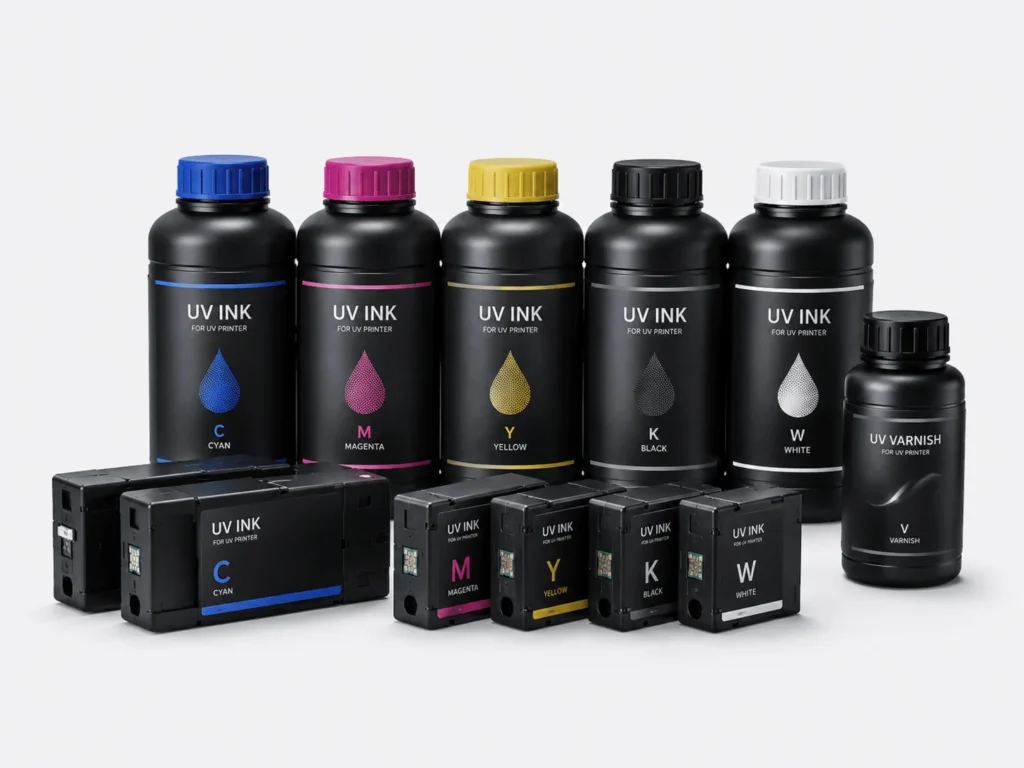
In the modern digital printing industry, UV ink and LED ink have become two widely used materials. Many factories face the decision of whether to upgrade to an LED system when selecting equipment or improving production lines, and they often hesitate between continuing with traditional UV ink or directly switching to LED ink.Although both inks belong to UV-curable systems, there are still significant differences in light source structure, energy consumption, equipment maintenance, and actual production workflow. For enterprises of different scales, the choice directly affects production costs, efficiency, product stability, and customer delivery speed.
Basic Differences Between UV Ink and LED Ink
Working Characteristics of UV Ink
In traditional printing industries, UV ink is a relatively mature system, and many older machines and factories still rely on it. It offers high stability and a well-established technical path, making it an “industrial-grade mature solution.”UV ink curing mainly relies on mercury lamp UV irradiation. After printing, the ink is quickly dried and cured under high-intensity ultraviolet light. Although the process seems simple, it requires relatively high equipment standards, including stable lamp power output and controlled operating temperature.During long-term operation, mercury lamps experience degradation and need regular replacement, which is a noticeable part of maintenance cost. For factories with stable production schedules and consistent order volumes, this system, although traditional, is still reliable.
Operating Mode of LED Ink
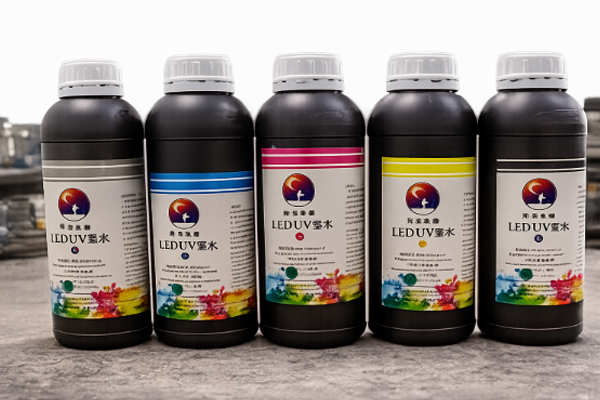
LED ink is a newer curing system that has developed rapidly in recent years, and many modern machines are directly equipped with LED light sources. Overall, it is more energy-efficient and designed for higher efficiency.LED ink uses LED UV light for curing and does not require preheating, allowing immediate operation after startup. Compared with traditional mercury lamps, it consumes less energy and generates less heat, making it gentler on printing materials.Thin or heat-sensitive materials perform more stably under LED systems and are less likely to deform or warp. In addition, LED lamps have a much longer lifespan and do not require frequent replacement, significantly reducing long-term maintenance costs. This makes it especially suitable for production environments with frequent start-stop operations or unstable order flow.
Core Differences Between the Two
Although both UV ink and LED ink belong to UV-curable systems, UV ink is more traditional and industrial-oriented, emphasizing stable output and continuous production capability but with higher energy consumption and fixed maintenance cycles.LED ink, on the other hand, represents a more modern production model, focusing on energy efficiency and flexible switching, making it suitable for multi-category and small-batch production.
Selection Logic Based on Different Production Needs
Large-Scale Industrial Production Requirements
For factories with large order volumes and stable production rhythms, equipment stability is often more important than flexibility, because downtime can affect the entire production line.In this case, UV ink still has certain advantages due to its mature system and stable process performance. It performs reliably during long continuous operation. Although mercury lamps involve energy consumption and maintenance issues, these are usually managed through established workflows in large-scale factories and do not significantly affect production schedules.
Such factories typically focus on:
- The production line must not stop easily
- Equipment must support long continuous operation
- Large order volume with stable efficiency
- Maintenance arranged at fixed intervals
Small and Medium Custom Production Requirements
With the rise of e-commerce customization and personalized products, order structures in small and medium-sized factories have changed significantly. Small-batch and multi-variety production has become the norm.LED ink performs better in this environment because it starts instantly without preheating and can switch between different jobs quickly. In scenarios such as phone case customization, gift personalization, and sample proofing, LED systems respond faster to customer demands and reduce waiting time.With lower maintenance costs, it is also easier for businesses with limited capital to control overall operating expenses.
Typical characteristics include:
- Fragmented but fast-changing orders
- Frequent design changes and job switching
- Short delivery deadlines
- Focus on overall cost rather than maximum output
Environmental Protection and Energy Consumption Requirements
Today, many companies consider energy consumption and environmental indicators when purchasing equipment, especially export-oriented enterprises.LED ink performs better in energy efficiency because LED light sources consume less power, do not require high-temperature mercury lamps, and reduce consumable replacement frequency. Over long-term operation, electricity and maintenance costs are significantly reduced.
Performance Comparison Between UV Ink and LED Ink
Curing Speed and Production Efficiency
Although curing speed may seem like a simple technical parameter, it directly affects the entire production workflow.UV ink already has fast curing speed, but it depends on stable mercury lamp output and requires a warm-up phase at startup. LED ink, however, is ready to use immediately, saving more time in frequent job switching.In small-batch or mixed-order production, LED systems show a clearer efficiency advantage because they do not require waiting for stable operating conditions.
Material Compatibility
Different materials respond differently to temperature and curing conditions, which affects final product quality.UV ink is suitable for most common materials such as acrylic, PVC, and metal. However, on thin plastics or heat-sensitive materials, slight deformation may occur.LED ink generates less heat and performs more stably on these materials, especially phone cases, film materials, and soft plastics, resulting in more consistent output quality and easier process control.
Maintenance Cost and Service Life
UV systems use mercury lamps as consumables, which require periodic replacement, and light decay gradually affects curing performance over time.LED systems rarely require light source replacement and have a much longer service life, resulting in significantly lower maintenance frequency.For factories operating multiple machines or running long production cycles, this difference can translate into substantial long-term cost savings.
Frequently Asked Questions
Is UV Ink Outdated?
Many people think UV ink has been replaced by LED technology, but this is not the case.UV ink is still widely used in large-scale industrial production. Many legacy production lines operate stably, proving that the technology is mature and reliable. Its main limitation lies in energy consumption and maintenance efficiency compared to LED systems.
Is LED Ink Suitable for All Equipment?
LED ink cannot be directly used in all UV equipment, and this is an important consideration.LED and mercury lamps emit different UV wavelengths. If the system is not matched correctly, curing may be incomplete or adhesion performance may decrease. Therefore, equipment and ink must be properly matched.
Can the Two Inks Be Mixed?
Mixing is not recommended in production.Because they belong to different curing systems, mixing them may cause uneven drying, surface stickiness, or reduced wear resistance, ultimately affecting product quality stability.
Although both UV ink and LED ink belong to UV-curable systems, they differ significantly in operating mechanisms and cost structures. UV ink is more aligned with mature and stable industrial production models, while LED ink represents a more energy-efficient and flexible modern digital production approach.The choice between them is not about technology being new or old, but about production requirements and business structure. Only by considering real application scenarios can companies select the most suitable solution and achieve a better balance between efficiency and cost control.