With the continuous upgrading of smart home appliances and kitchen appliances, induction cookers are no longer just simple heating devices. Appearance texture, functional identification, and durability have all become key concerns for consumers. Among them, the glass panel, as the most visible display area of an induction cooker, must not only withstand high temperatures, oil stains, and frequent cleaning, but also maintain clear patterns, accurate markings, and an attractive overall appearance over time. Traditional screen printing often faces problems such as long plate-making cycles, inflexible modifications, and relatively high overall costs when dealing with multiple models, small batches, and personalized designs. In contrast, UV digital inkjet printing technology can better meet the production needs of induction cooker glass panels, helping enterprises achieve high-precision, high-efficiency, and high-value manufacturing.
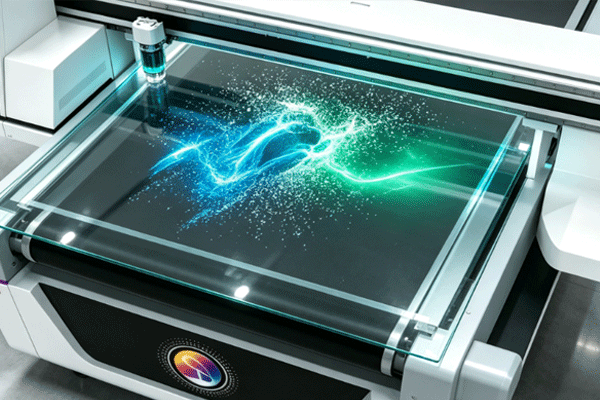
Core Requirements of Induction Cooker Glass Panels for Printing Processes
The glass panel is not only decorative, but also an important user interface, so the requirements for the printing process are very strict.
Requirements for High Durability and Environmental Adaptability
During daily use, induction cookers are often exposed to high temperatures, steam, and oil fumes, which means the panel graphics cannot pursue only short-term effects, but must deliver long-term stable performance.
- Panel graphics need strong heat resistance so they can remain intact in long-term heating environments without obvious deformation or distortion caused by temperature changes.
- Surface markings must resist oil stains, cleaning agents, and daily wiping, avoiding blur or peeling after repeated cleaning.
- After long-term use, there should be no fading, ink shedding, or fuzzy edges, otherwise the product grade and user experience will be directly affected.
- The panel must still maintain a good appearance after frequent wiping, so it can truly adapt to the real needs of high-frequency use and maintenance in kitchen scenarios.
The printing process must balance adhesion, wear resistance, and stability. Only in this way can it meet the long-term service life requirements of kitchen appliances.
Clear Functional Markings and Visual Design Requirements
The icons, text, and functional zoning on an induction cooker panel directly affect user operation efficiency and safety, so the printed content must be sufficiently clear, intuitive, and easy to recognize.
- Function buttons must be clearly distinguishable, especially during quick operation, so blurred graphics do not affect judgment.
- Numbers and symbols need to be presented with high contrast, so they can be quickly identified even in dim kitchen lighting.
- They must remain easy to recognize in low-light environments to avoid increasing the risk of misoperation due to poor visibility.
- The overall design style should match modern home appliance aesthetics, being both simple and elegant while staying consistent with the brand positioning.
The higher the clarity and visual appeal, the easier it is for the product to gain consumer recognition, while also helping brand image building and terminal sales conversion.
Advantages of UV Printing Technology in Glass Panel Applications
UV digital inkjet printing technology provides a more flexible and efficient solution for glass panel processing, especially suitable for home appliance products with high requirements for both appearance and function.
UV Curing Improves Adhesion and Wear Resistance
UV printing uses ultraviolet light to rapidly cure the ink, allowing the pattern to adhere more firmly to the glass surface and significantly improving the stability and service life of the finished product.
- The ink can be instantly cured after printing, reducing diffusion and bleeding, and making the pattern edges cleaner.
- The edges of the pattern become sharper and clearer, better presenting small text, icons, and functional lines.
- It enhances scratch resistance and cleaning resistance, so the surface can still maintain a good appearance even under frequent wiping.
- It extends the service life of the panel and reduces rework and after-sales issues caused by pattern damage.
This process is especially suitable for high-frequency kitchen appliance products and can achieve a better balance between appearance and practicality.
Supports Complex Patterns and Multi-Color Designs
Modern home appliances increasingly emphasize appearance design and brand differentiation. Induction cooker glass panels are no longer just simple functional carriers, but an important expression of brand aesthetics.
- High-definition color pattern output can be achieved, making the panel more layered and modern visually.
- It supports gradients, textures, and detail-rich designs, meeting the diverse style expression needs of different brands.
- It can satisfy different brand visual styles, whether minimalist, tech-oriented, or premium, all of which can be flexibly presented.
- Patterns can be switched quickly without plate-making, greatly shortening proofing and modification cycles and improving design response speed.
Compared with traditional processes, UV printing has obvious advantages in flexibility and design freedom, making it more suitable for diversified product development and a rapidly iterating market environment.
The Value of Conveyor-Type UV Printing in Mass Production
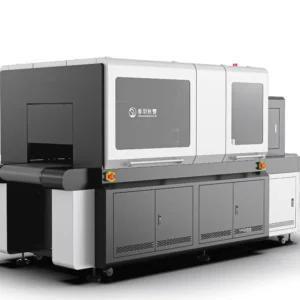
Induction cookers are highly standardized home appliances, so production efficiency is especially important. Conveyor-type UV printing is well suited to this continuous manufacturing demand.
Continuous Feeding Improves Production Efficiency
The conveyor structure is more suitable for assembly-line production models and helps enterprises increase overall output while ensuring quality.
- Automatic feeding reduces manual handling and repetitive operations, making the production process smoother.
- Continuous printing improves overall output and is suitable for stable delivery of large-volume orders.
- It reduces loading and unloading time losses, allowing the equipment to complete more tasks in less time.
- It is more suitable for large-volume order delivery, especially for standardized home appliance mass production.
For manufacturing enterprises that pursue efficiency, this model can significantly improve production rhythm and is also beneficial for stable delivery schedules and optimized labor allocation.
Fast Switching Capability for Multiple Models
Induction cooker products are updated quickly, with frequent changes in models and panel styles. Therefore, the equipment must have strong switching capability to adapt to market changes.
- It supports fast switching between different panels, reducing downtime caused by model changes.
- Designs can be adjusted without re-plate-making, making new product development and sample testing more efficient.
- It is suitable for small-batch, multi-version orders and can meet the flexible needs of brands for differentiated products.
- It shortens new product development and trial production cycles, enabling enterprises to move faster from design to mass production.
This flexibility helps enterprises respond quickly to market changes and better adapt to customization trends and diversified consumer demands.
Key Quality Control Points for Glass Panel UV Printing
Stable quality output is a basic requirement in the home appliance industry, especially for exterior parts, where even minor defects can affect the consumer’s first impression of the product.
Color Consistency Control
Home appliance brands place very high demands on appearance consistency, and any color difference may affect the overall texture. Therefore, color consistency must be strictly controlled in mass production.
- Software-based automatic color calibration systems can effectively improve output stability across different batches and make color performance more uniform.
- Keeping ink volume and printing parameters consistent during production helps reduce visual differences between batches.
- Ensuring that different panels present a unified style within the same brand system enhances brand recognition.
- Improving the stability of visual effects makes the product look more premium and professional in terminal displays.
To understand the quality control focus more intuitively, you can refer to the table below:
| Quality Control Item | Main Function | Impact on the Product |
| Color Consistency | Ensures uniform appearance across batch products | Enhances brand image |
| Adhesion Test | Checks whether the pattern is firmly attached | Reduces peeling risk |
| Wear Resistance Test | Verifies surface scratch resistance | Extends service life |
| Heat Resistance Test | Ensures stability in high-temperature environments | Adapts to kitchen use scenarios |
| Cleaning Test | Evaluates oil-stain resistance | Maintains long-term appearance |
Surface Process and Protection Optimization
In addition to the pattern itself, surface protection is equally important, because induction cooker panels frequently come into contact with fingers, oil stains, and cleaning tools during actual use.
- Anti-fingerprint coating effects can be added to help the panel stay clean more easily in daily use.
- Oil-stain and corrosion resistance can be improved, making the panel more durable and easier to maintain in kitchen environments.
- Wear resistance and scratch resistance can be enhanced, reducing appearance damage caused by friction over long-term use.
- The overall touch and visual texture can be improved, making the product more in line with high-end home appliance positioning.
After optimization, the panel better matches the market positioning of premium home appliances and more clearly reflects the brand’s attention to detail and quality.
Why the Induction Cooker Industry Chooses UV Printing Solutions
As the smart kitchen trend continues to develop, appearance and functionality have become equally important, and the production method of induction cooker panels is therefore entering a new stage of upgrading.
Meets the Trends of Personalization and Premiumization
Consumers are demanding more from the appearance of home appliances, and induction cookers are no exception. Today’s induction cookers must not only meet basic cooking functions, but also offer more diverse design styles to suit different home decoration aesthetics and usage habits. At the same time, brands hope to strengthen product recognition through differentiated appearances, so customized pattern production has gradually become a market trend. Whether it is a minimalist style, a tech style, or a premium textured style, flexible appearance design can help products improve overall competitiveness. It can be said that appearance design has become an important selling point for induction cooker products and is playing an increasingly critical role in terminal purchasing decisions.
Reduces Overall Production Costs
Compared with traditional screen printing, UV printing has more advantages in overall cost, especially for manufacturing enterprises that pursue a balance between efficiency and profit.
- It reduces plate-making and mold investment, effectively lowering upfront development costs.
- It shortens production cycles, allowing enterprises to complete order delivery and new product launches faster.
- It reduces dependence on manual operations, making the production process more stable and easier to standardize.
- It improves material utilization and reduces waste caused by trial-and-error and rework.
For enterprises pursuing both efficiency and profit balance, this solution is more attractive and better suited for long-term development and large-scale expansion.
As the smart home appliance industry continues to upgrade, induction cooker glass panels are facing increasing demands for high precision, high durability, and high-efficiency production. UV digital inkjet printing technology, with its stable output capability, flexible production mode, and strong material adaptability, is becoming one of the mainstream solutions in the industry. Springyprinter focuses on the R&D and manufacturing of industrial UV digital printing equipment and can provide customers with professional glass panel UV printing solutions and technical support services.