As smart home products continue to gain popularity, smart speakers have evolved from simple voice devices into an important medium for home interaction and brand presentation. As one of the first components users see and the part they interact with most frequently, the control panel must not only carry functional labels, touch prompts, and decorative elements, but also deliver wear resistance, stain resistance, and long-term stability. Traditional processes such as screen printing and lamination often face issues such as long plate-making cycles, inflexible modifications, and high overall costs when dealing with multi-version, small-batch, and high-precision requirements. In comparison, UV digital inkjet printing is better suited to the modern production needs of smart speaker control panels, helping companies improve efficiency, optimize quality, and strengthen product competitiveness.
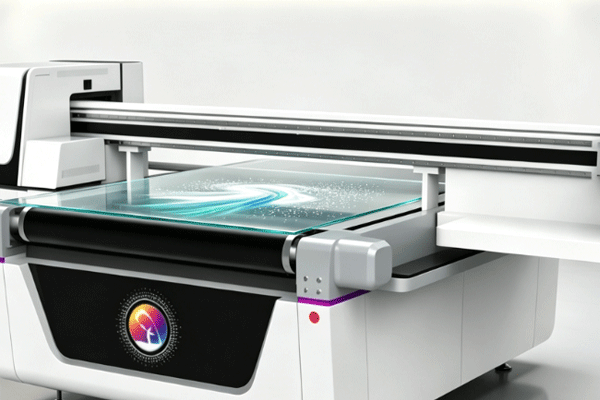
What Printing Requirements Do Smart Speaker Control Panels Have?
Smart speakers are not only functional products, but also part of home aesthetics. Therefore, panel printing must balance visual appeal and user experience. It should allow users to instantly understand the functional areas while maintaining stable appearance performance during long-term use.
Graphics and Labels Must Be Clear and Precise
Control panels usually include button icons, indicator light areas, functional text, and decorative lines. Although these elements are small in size, they directly shape the user’s first impression of the product’s professionalism and brand image. Therefore, every detail must be printed clearly, accurately, and consistently to avoid blurred edges, misalignment, or unstable color that could affect the overall texture of the device.
- Icon edges must be sharp and free of burrs or jagged lines, otherwise the panel will look less refined.
- Small text must remain highly legible, especially in nighttime or low-light environments where users still need to identify it easily.
- Multi-layer graphics must be precisely aligned to avoid misplacement between functional and decorative areas.
- Color transitions should be smooth, without obvious breaks or color differences, to enhance overall visual consistency.
High-precision output not only improves the refined appearance of the panel, but also makes it easier for users to identify functional areas during actual operation, thereby enhancing the overall user experience and market appeal of the product.
Surface Performance Must Support Long-Term Use
Smart speakers are usually placed in high-frequency use environments such as living rooms and bedrooms. The panel must withstand daily touch, dust, oil stains, and environmental changes. Therefore, the printed surface performance must be stable enough to ensure that the product remains in good condition after long-term use and does not suffer from fading, wear, or reduced adhesion due to frequent contact.
- The panel needs strong scratch and wear resistance so it will not easily leave marks during long-term touching and cleaning.
- The surface should reduce fingerprint and oil residue to maintain appearance and improve cleaning convenience.
- It should not fade easily after long-term use, ensuring that brand logos and functional graphics remain clear.
- It must adapt to changes in temperature and humidity to maintain stable performance in home environments.
The panel material and ink adhesion must be stable and reliable. Only in this way can the control panel truly combine aesthetics, durability, and consistency in mass production.
How Does UV Printing Technology Meet Control Panel Production Needs?
UV digital inkjet technology, with its fast curing and strong adaptability, has become an important solution for smart speaker panel printing. It not only enhances graphic performance, but also helps companies achieve a better balance between production efficiency and process flexibility.
UV Curing Improves Adhesion and Durability
UV printing uses ultraviolet light to rapidly cure the ink. This process effectively reduces ink spreading and graphic deformation, while allowing the printed layer to adhere more firmly to the panel surface. As a result, it meets the wear resistance and long-term stability requirements of smart speaker control panels and reduces the risk of fading or peeling during subsequent assembly and use.
- Ink does not spread easily, so graphics remain clearer and better reproduce the details of the original design.
- Fast curing speed makes it suitable for continuous production and helps improve the rhythm of the entire production line.
- Adhesion of the ink layer is enhanced, reducing the risk of peeling and improving stability during long-term use.
- Surface wear and scratch resistance are improved, making the product more suitable for high-frequency touch scenarios.
This process is especially suitable for control panels that are frequently touched, and it is also ideal for manufacturing scenarios that pursue high-quality appearance and stable batch delivery.
Direct Printing on Multiple Materials
Smart speaker panels are made from a variety of materials. UV printing offers strong compatibility and can adapt to products with different brands, positioning, and design styles, giving companies greater flexibility in material selection and making new product development and sample validation more efficient.
| Panel Material | Applicable Features | Printing Advantages |
| Acrylic | High transparency, strong decorative appeal | Clear graphics, excellent visual effect |
| PC/PVC | Moderate cost, easy processing | Suitable for mass production |
| Glass | Premium texture, refined appearance | Enhances product grade |
| Composite materials | Stable structure, wide applications | Strong compatibility, high flexibility |
Direct output without plate-making greatly shortens production cycles and makes companies more efficient in new product development, sample proofing, and multi-version switching.
Advantages of Conveyor-Type UV Printing in Mass Production
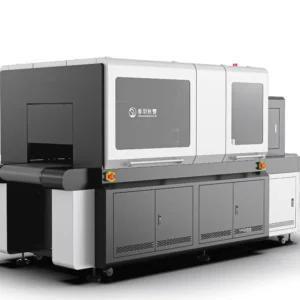
For smart speakers, which combine standardization and customization, conveyor-type UV printing offers greater efficiency advantages. It is suitable for continuous production and can also meet the practical need for rapid switching between different panel graphics, making it highly valuable in factory-scale manufacturing.
Continuous Conveying Improves Output
Conveyor-type equipment is suitable for assembly-line production. It closely connects the loading, printing, and unloading stages, reducing manual intervention and waiting time. This allows companies to complete more orders in the same amount of time and maintain a more stable production rhythm when facing concentrated delivery tasks.
- Automatic feeding reduces manual handling and makes the workflow smoother.
- Continuous printing increases output per unit time, making it suitable for medium and large batch orders.
- Reduced waiting time during loading and unloading minimizes inefficiencies in the production process.
- It is more suitable for medium and large batch order delivery and also helps factories manage production in a standardized way.
This model helps companies respond more quickly to market demand and is especially suitable for factory customers who pursue stable delivery times and large-scale production.
More Flexible Multi-Version Switching
Smart speaker products are updated quickly, with frequent model changes. Different series often correspond to different panel graphics and functional layouts. Therefore, whether the equipment supports fast switching directly affects a company’s R&D efficiency and order response capability. Different panel graphics can be switched quickly, production can proceed without re-plate-making, and it is suitable for small-batch, multi-batch orders. It also supports new product development and trial production. Flexible production capability is an important competitive advantage for brand manufacturers and a key factor in maintaining rapid iteration in a highly competitive market.
Key Quality Control Points for Smart Speaker Panel Printing
To make control panels both attractive and durable, quality control must be strictly managed. In reality, what determines product reputation is often not a single printing result, but stable performance in long-term mass production. Therefore, neither color nor surface treatment can be neglected.
Color Consistency Must Be Stable
Brand products have very high requirements for appearance consistency. This is especially true for smart speakers, which are consumer-facing terminal products. Any obvious color difference may affect users’ perception of the brand’s professionalism. Therefore, color control must run through the entire production process and maintain as consistent an output state as possible across different batches and shifts.
- Color differences between batches should be minimized to avoid obvious visual discrepancies in the same product model.
- Software color calibration functions must be accurate and reliable to ensure the printed result matches the design file.
- Ink volume control must remain consistent to prevent areas from appearing too dark or too light.
- The visual effect of different orders should remain unified so the brand image stays stable and professional.
Stable color performance helps enhance brand professionalism and allows products to maintain a unified visual identity across different batches and channels.
Surface Finishing Should Be Further Optimized
In addition to the graphics themselves, the surface effect also influences user experience. This is especially important for smart speakers, which are frequently touched. The panel’s feel, gloss, and stain resistance all directly affect consumer perception. Therefore, after printing, surface finishing should be further optimized.
- A non-slip or tactile layer can be added to give users a more natural touch response during operation.
- Fingerprint resistance can be improved to reduce marks and cleaning effort from daily use.
- Corrosion and wear resistance can be enhanced to extend the product’s service life in home environments.
- Matte or glossy visual effects can be optimized to better match different brand positioning.
Good surface treatment can extend product life and make smart speakers better aligned with the positioning of high-end home products in both appearance and feel.
Why Is UV Printing a Better Choice for the Smart Speaker Industry?
As the smart home market continues to expand, companies are placing higher demands on panel printing. Traditional processes can no longer easily meet the three requirements of efficiency, flexibility, and quality at the same time. UV printing, however, is more in line with modern manufacturing rhythms and better suited to the fast-iterating consumer electronics industry.
Better Aligned with the Trend Toward Personalization
Consumers are paying more and more attention to the appearance and texture of smart products. Smart speakers are no longer just functional devices; they are part of the home environment. Brands therefore need richer design language to increase product appeal. Smart speaker panel printing must not only support differentiated brand design, but also enable diverse UI styles, meet customization and small-batch needs, and further enhance product value and market attractiveness. Appearance innovation has become an important direction in smart speaker competition, and UV printing provides a more flexible way to achieve this innovation.
More Cost-Effective Overall
Compared with traditional processes, UV printing is better suited to modern manufacturing rhythms. It not only reduces upfront plate-making investment, but also lowers the cost of later modifications and rework. This allows companies to control budgets while maintaining high production efficiency, and still remain flexible when handling multi-model and multi-batch orders.
- Reduces plate-making and mold investment, lowering initial development costs.
- Reduces dependence on manual operations, making the production process more standardized.
- Improves material utilization and reduces waste caused by rework and scrap.
- Shortens the overall production cycle, helping companies complete orders faster.
Overall cost control is more advantageous and better suited to smart home manufacturers that pursue fast delivery and continuous optimization.
As the smart home industry continues to upgrade, smart speaker control panels are placing increasing demands on high precision, durability, and flexibility. UV digital inkjet printing technology, with its stable output, multi-material compatibility, and high-efficiency production advantages, is becoming an important solution in this field. Springyprinter specializes in the R&D and manufacturing of industrial UV digital printing equipment and can provide customers with professional smart panel printing solutions and technical support services.