The upgrade in consumer demand is driving home appliances toward higher quality and more aesthetically appealing designs. Products such as refrigerators, ovens, washing machines, and air purifiers increasingly rely on exterior design as a key factor influencing consumer decisions. Exterior panels are not only decorative elements but also need to clearly display brand logos, functional icons, and operational information, balancing aesthetics and practicality. With faster product iteration, multi-model production, and growing customization demands, traditional printing methods are gradually becoming insufficient in terms of efficiency and flexibility. Digital UV printing solutions can ensure excellent visual performance while delivering stable quality and efficient production, providing strong support for home appliance manufacturers to enhance competitiveness.
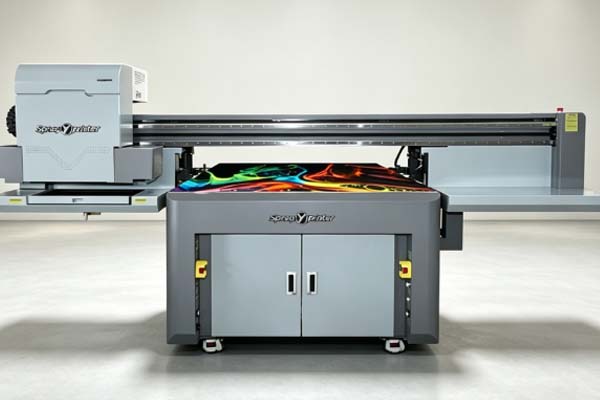
Meeting High-End Appliance Panel Printing Requirements
In high-end home appliance manufacturing systems, exterior panels are not only structural components but also important carriers of brand image and product value. Their visual performance directly affects consumers’ first impressions.
Delivering Refined Visual Effects
High-end home appliances emphasize overall harmony and detailed texture, and printing quality directly influences product positioning and market perception.
- Rich and natural color reproduction with clear layering, enhancing realism and premium feel.
- Sharp and recognizable brand logos, even on complex backgrounds.
- Realistic reproduction of brushed metal, wood grain, and other textures.
- Uniform large-area color blocks with no obvious color deviation.
- Clear and complete graphic details, improving overall refinement.
Enhanced visual quality helps improve the overall product texture and strengthens both retail display impact and purchase intent.
Supporting Multiple Material Applications
Modern appliance panels use a wide variety of materials, requiring higher adaptability and stability in printing processes.
- Glass panels enable high-transparency, high-adhesion color printing, enhancing technological appeal.
- Acrylic parts achieve high-saturation color output while maintaining smooth and transparent surfaces.
- Metal components support durable, high-adhesion printing suitable for long-term use.
- PVC and composite materials enable stable mass production with balanced cost and efficiency.
- Special decorative boards support multi-process compatibility for differentiated design needs.
To more intuitively present material differences, the comparison is as follows:
| Material Type | Application Scenario | Printing Advantages | Product Use Case |
| Glass | High-end control panel | High transparency, premium visual clarity | Refrigerator, Oven |
| Acrylic | Decorative panel | Strong color performance, high design freedom | Air purifier |
| Metal | Structural housing | High durability, impact resistance, industrial feel | Washing machine |
| PVC/Composite | Functional panel | Cost-effective, highly processable, suitable for mass production | Small appliances |
Improved multi-material compatibility gives companies greater design freedom in product development and provides a stronger technical foundation for product line expansion.
Improving Production Efficiency and Quality
In an increasingly competitive market, production efficiency and quality stability are key to rapid response capabilities.
More Efficient Digital Production
Digital production simplifies workflows and improves controllability through data-driven processes. It eliminates traditional plate-making and proofing steps, allowing design files to go directly into production, significantly reducing preparation time. It also supports fast import and adjustment of multiple file formats, making product development and modification more flexible and efficient, and shortening the cycle from design to mass production, enabling faster market response. At the same time, it supports small-batch and multi-lot trial production, reducing development risks, while maintaining stable output in continuous production and improving equipment utilization. This efficient and flexible model allows companies to better respond to rapidly changing market demands.
Maintaining Stable Print Quality
Consistent and stable output quality is a fundamental requirement of high-end manufacturing.
- Color management systems improve color consistency and accuracy.
- Batch production maintains stability across different runs.
- High-precision positioning reduces pattern deviation.
- Reduced instability caused by manual intervention.
- Improved overall yield rate and first-pass qualification rate.
Stable quality not only reduces rework losses but also strengthens long-term customer trust in the brand.
Supporting Flexible Manufacturing Upgrades
The diversification of product models and accelerating market changes make flexible manufacturing a core competitive capability.
Supporting Multi-Model Mixed Production
In a multi-category parallel production environment, manufacturing systems must have fast switching and efficient coordination capabilities to handle complex orders. This enables rapid switching between different products, reducing downtime and adjustment time, while supporting simultaneous scheduling of multiple designs, improving production planning flexibility and execution efficiency. It also meets the needs of brand series development, ensuring consistent design style across different models, reducing inventory pressure, and improving equipment and production line utilization. As a result, companies can achieve more stable output and faster response in dynamic markets.
Reducing Overall Manufacturing Costs
Cost structure optimization is achieved through process improvement.
- Reduced labor dependency and improved standardization.
- Lower material waste during trial production and debugging.
- Reduced reprinting and rework costs.
- Improved continuous equipment operation efficiency.
- Optimized overall production workflow integration.
Systematic cost optimization enables companies to maintain quality while achieving stronger price competitiveness.
Enhancing Product Market Competitiveness
Exterior design and manufacturing capability have become key directions for brand differentiation.
Increasing Brand Added Value
High-quality exterior design not only improves visual performance but also strengthens brand value and market recognition.
- Enhances product display attractiveness at retail terminals.
- Increases visual impact and consumer dwell time.
- Improves visual hierarchy and functional zoning.
- Meets the aesthetic expectations of high-end users.
- Strengthens brand recognition and memorability.
More design-oriented appearances help improve product competitiveness and brand premium in the market.
Supporting Future Smart Manufacturing Development
As manufacturing moves toward digitalization and intelligence, printing technology is becoming an important part of smart manufacturing systems.
- Can integrate with automated production lines to improve coordination efficiency.
- Supports intelligent order management for precise task allocation and execution.
- Improves development efficiency from design to mass production, accelerating product launch.
- Adapts to global market requirements, enhancing international competitiveness.
- Promotes digital transformation and the establishment of modern manufacturing systems.
Continuously improving digital printing capabilities will help companies build a stronger technological foundation and long-term competitive advantage.
Through advanced UV digital printing technology, home appliance panels can achieve comprehensive improvements in visual presentation, production flexibility, and cost control, helping companies maintain competitive advantages in a rapidly changing market environment. Springyprinter focuses on the R&D and application of industrial digital printing equipment, dedicated to providing efficient and stable UV digital printing solutions for home appliance exterior panels.