In today’s rapidly evolving consumer electronics market, product shell customization has shifted from simple decoration to a key strategy for brand differentiation and product value enhancement. Whether it is phone cases, earbud charging cases, power bank housings, or smart device control panels, users increasingly expect more personalized and visually appealing designs that reflect identity and brand aesthetics. UV printing, with its high precision, strong adhesion, and wide material compatibility, is becoming widely used in electronic product shell customization and is now an important process for improving product value and production efficiency.
Core Advantages of UV Printing in Electronic Shells
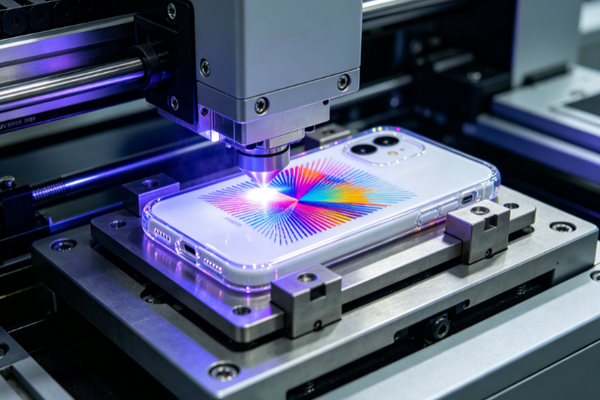
UV printing has become popular in electronic product shell customization because it delivers both high-quality visual performance and strong adaptability to different materials, making it ideal for modern fast-paced customization demands.
In practical applications, it provides:
- High-resolution image output with photo-level detail and gradient effects
- Instant UV curing for strong adhesion and resistance to scratches or fading
- Plate-free process, allowing direct production after design changes
- Compatibility with materials such as PC, ABS, and coated metal surfaces
These features allow UV printing to balance efficiency and quality, especially in multi-SKU production environments.
Common Applications in Electronic Product Shell Customization
With the rapid expansion of smart devices, electronic shells are no longer just protective components but also key carriers of branding and personal expression. UV printing is widely applied across multiple consumer electronics scenarios.
In production, it is commonly used for:
- Custom phone and tablet cases for branding and personalization
- Earbud charging case printing to enhance product identity and design appeal
- Power banks and portable chargers for improved visual attractiveness and marketing impact
- Smart home control panels combining functional labeling with decorative design
These applications not only enhance appearance but also increase product competitiveness in the market.
Material Compatibility of UV Printing
Electronic product shells come in various materials, each requiring different printing performance standards. UV printing stands out due to its strong material adaptability, covering most common electronic shell production needs.
In real production, it performs as follows:
- Stable adhesion on PC and ABS plastics without easy peeling
- High-quality visual results on coated metal surfaces
- Reliable printing on curved or slightly arched structures
- Improved adhesion on special coatings when primer is applied
This broad compatibility improves production flexibility and reduces process limitations.
Key Factors in Improving Efficiency and Reducing Cost
In batch customization production, efficiency and cost control are always top priorities. UV printing offers clear advantages in workflow optimization and flexible production.
In actual operations, it enables:
- Plate-free workflow, allowing rapid production after design confirmation
- Lower prototyping cost for small-batch orders
- Continuous automated production with reduced manual intervention
- Mixed-design production to maximize machine utilization
This model is especially suitable for e-commerce customization and fast-moving product markets.
Advantages of UV Printing in Design Performance
Electronic product shells are not only functional parts but also visual carriers of brand identity. UV printing offers high design flexibility and strong visual expression capabilities.
It supports:
- Gradient colors, high-resolution images, and complex patterns
- Local UV gloss effects for enhanced texture and layering
- Fully personalized designs with one-piece-per-design production
- High color saturation suitable for strong brand expression
This design freedom helps products stand out in competitive markets.
Production Considerations for UV Printing on Electronic Shells
In real manufacturing processes, several key factors must be controlled to ensure stable quality and consistent output.
Important considerations include:
- Proper surface cleaning to avoid oil or dust affecting adhesion
- Matching inks and primers based on different material types
- Adjusting printing parameters according to design and material
- Using stable fixtures for curved products to prevent misalignment
Standardized process control significantly improves yield and consistency.
As electronic product shell customization continues to evolve, UV printing has become one of the mainstream processes due to its high precision, strong material compatibility, and flexible production capabilities. It not only enhances product appearance but also enables faster response to changing market demands. UV printing is driving the electronic shell industry toward higher efficiency and higher-quality production. SpringYprinter provides reliable and efficient UV printing solutions for modern manufacturing needs.