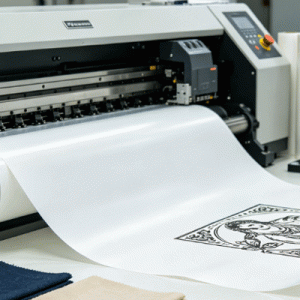
With the continued growth of garment customization, personalized printing, and flexible manufacturing markets, DTF (Direct to Film) printing equipment has attracted increasing attention from entrepreneurs, print factories, and brand processing companies. However, many buyers quickly notice that even though they are all DTF printers, prices can range from a few thousand yuan to several hundred thousand yuan, with a very obvious gap. This price difference does not come from brand factors alone, but is closely related to equipment configuration, printing performance, core components, and after-sales service. Understanding the main factors that affect DTF equipment pricing helps companies choose the most suitable machine based on their own production needs and achieve a higher return on investment.
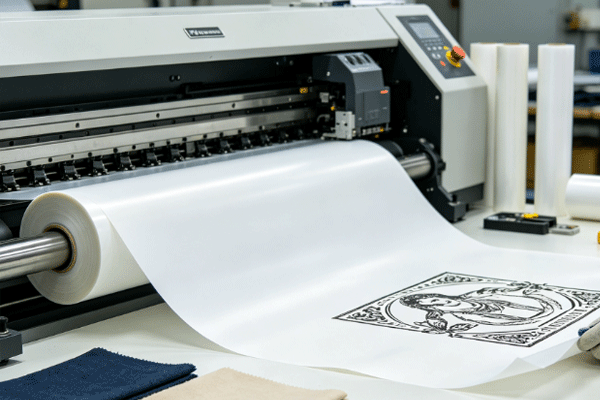
Different Core Configurations Naturally Lead to Different Prices
The basic configuration of a machine often determines its starting point and directly affects its production performance. For DTF equipment, the more stable and advanced the core components are, the higher the overall machine price usually is. These configurations not only affect print quality, but also influence equipment lifespan and daily operating efficiency.
Printhead Configuration Determines Equipment Value
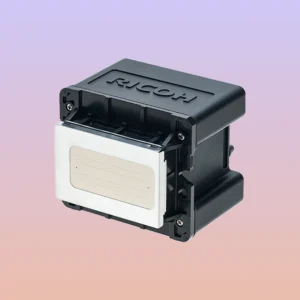
The printhead is the most important core component of a DTF printer, and its brand, quantity, and precision level often directly determine the cost range and market positioning of the machine.
- Different printhead brands vary significantly in purchase cost, stability, and service life, which directly widens the price gap of the whole machine.
- The more printheads a machine has, the larger the image area it can output per unit of time, and the higher its printing speed and production capacity.
- Industrial-grade printheads usually have stronger continuous working capability and are suitable for long-hour batch production, so their overall cost is higher than standard configurations.
- High-precision printheads can make image edges sharper and color transitions smoother, making them more suitable for orders with higher image quality requirements.
The higher the printhead configuration, the stronger the overall machine performance, and the higher the price. Therefore, companies should evaluate based on order volume and production capacity needs when purchasing, so as not to sacrifice long-term production efficiency for a lower price.
Mainboard and Control System Affect Stability
The control system determines how the machine performs, while mainboard performance, data processing capability, and software compatibility all greatly affect the actual user experience and long-term stability.
- A high-performance mainboard can process print data faster and maintain more stable operation when outputting complex images.
- With more stable data transmission, the machine is less likely to experience lag, disconnection, or image misalignment during long continuous printing.
- More advanced control systems usually support higher printing speeds and more flexible parameter adjustments, making them suitable for diversified order production.
- The more complete the system compatibility, the better the adaptability between the machine, software, consumables, and future upgrade solutions.
A stable control system can reduce failure rates and improve production efficiency, which is one of the important reasons why high-end equipment is more expensive, because it directly determines whether the machine can serve factory production reliably over the long term.
Mechanical Structure and Automation Configuration Affect Long-Term Cost
In addition to core electronic components, the machine’s structural design and automation level also significantly widen the price gap. Many users initially focus only on print results, while overlooking the impact of mechanical structure on stability, maintenance cost, and long-term user experience. In fact, these are key factors that determine equipment value.
Differences Exist in Machine Manufacturing Quality
The machine structure is directly related to operating stability, and the frame material, guide rail precision, and transmission system manufacturing standards all greatly affect performance during high-speed operation.
- A reinforced frame can effectively reduce vibration during high-speed operation, making the printing process smoother.
- High-precision guide rails ensure smoother printhead movement, reduce deviation errors, and improve image positioning accuracy.
- A high-quality transmission system performs more stably during long-term operation and lowers the risk of mechanical wear-related failures.
- Machines with more reasonable structural design are usually better suited for continuous work, so they perform more reliably in batch production scenarios.
Although higher structural standards increase manufacturing costs, they also effectively extend equipment lifespan and reduce maintenance pressure. From a long-term business perspective, they are often more cost-effective.
Automation Configuration Improves Production Efficiency
The higher the automation level, the higher the value of the equipment. These automation functions not only reduce manual intervention, but also make the entire production process smoother and more stable. For example, an automatic film feeding and rewinding system reduces manual operation frequency, automatic moisturizing and cleaning functions help maintain stable printhead condition, a white ink circulation system helps solve white ink sedimentation issues, and an intelligent ink shortage alarm helps operators detect abnormalities in time and avoid rework caused by insufficient consumables. These configurations reduce manual intervention, make the machine more suitable for continuous production, and further improve overall production efficiency and stability. Therefore, the higher the automation level, the higher the equipment price usually is.
Print Quality and Production Capacity Determine Equipment Grade
A machine must not only be able to print, but also strike a balance between speed and quality. This is another major reason for price segmentation. Different customers have different requirements for image precision, color performance, and delivery speed, so equipment grades naturally vary.
Printing Speed Affects Market Positioning
Different companies have different production capacity needs, and printing speed often directly determines which type of orders the machine is best suited for, which also affects its market price level. Entry-level machines are more suitable for small-batch and sample orders and can meet the basic production needs of startups; mid- to high-end machines support longer continuous printing and are better suited for factories with stable orders and tighter delivery schedules; multi-printhead configurations can significantly increase daily output and are suitable for businesses that require fast delivery of large-volume orders; high-speed modes are more suitable for large-scale production, helping companies maintain higher shipment efficiency during peak seasons. In general, the faster the machine, the higher the price, and the more suitable it is for factories with higher requirements for delivery time and production capacity.
Color Performance Affects Product Quality
High-quality output depends on excellent configuration, and color reproduction, white ink coverage, and detail performance all directly affect the market competitiveness of the finished product.
- When color transitions are smoother, the image looks more refined and better meets brand customers’ expectations for visual quality.
- When white ink coverage is more even, the printed image on dark fabrics appears fuller and the finished product looks more consistent.
- When image details are sharper, small text, lines, and complex graphics can be reproduced better, reducing the chance of rework.
- When product consistency is higher, quality fluctuations in batch orders are smaller, which helps build customer trust.
For brand apparel and high-end customization markets, superior print quality can increase product added value and make it easier to gain customer recognition, which is why high-image-quality machines are usually more expensive.
Brand, After-Sales Service, and Purchasing Strategy Affect the Final Investment
Many buyers only look at the equipment quotation and ignore the technical accumulation and long-term service capability behind the brand. In fact, equipment price reflects not only the machine itself, but also hidden value such as R&D capability, quality control, and after-sales service systems.
Brand Strength Provides Greater Assurance
Established brands usually have strong R&D capabilities, and this accumulation of experience and market validation is often directly reflected in equipment stability, user experience, and maintenance convenience.
- After long-term market validation, products usually have stronger stability and adaptability, with lower usage risk.
- When quality control is stricter, factory testing and calibration are more complete, and the failure rate in later use is lower.
- Brands with faster technological updates can adapt more quickly to market changes and customer needs.
- When spare parts supply is more stable, maintenance and upgrades become easier and more convenient, which is better for continuous production.
Brand value is reflected not only in the machine itself, but also in long-term user experience and production assurance. Therefore, higher-priced branded equipment is often more suitable for companies that prioritize stable operations.
After-Sales Support and Purchasing Strategy Are Equally Important
Equipment operation depends on professional service, and installation, training, maintenance, and response speed all directly affect a company’s actual usage cost and production continuity.
- Manufacturers that provide installation and commissioning guidance can help users enter normal production more quickly and reduce initial trial costs.
- When operation training is more complete, employees can get up to speed faster and reduce losses caused by misuse.
- A faster fault-response service system can effectively reduce downtime and ensure order delivery schedules.
- When later maintenance is more convenient, the long-term cost of equipment use becomes more controllable and business pressure is reduced.
When purchasing, companies should not only look at the initial price, but also comprehensively evaluate later maintenance costs, consumable costs, equipment stability, and long-term production efficiency. Equipment that fits their own order structure is often more valuable than a machine that is simply cheaper.
The large price difference in DTF equipment is determined by multiple factors, including printhead configuration, mechanical structure, automation level, printing performance, brand strength, and after-sales service. When purchasing equipment, companies should not focus only on the initial purchase price, but should make a comprehensive judgment based on their own order types, production scale, and future development plans. Choosing stable, reliable, and performance-matched equipment is the only way to truly improve production efficiency and market competitiveness. Springyprinter focuses on the R&D and manufacturing of industrial digital printing equipment and can provide customers with professional DTF printing solutions and technical support services.