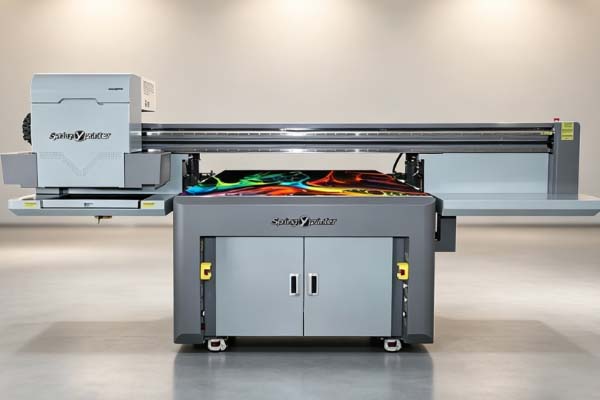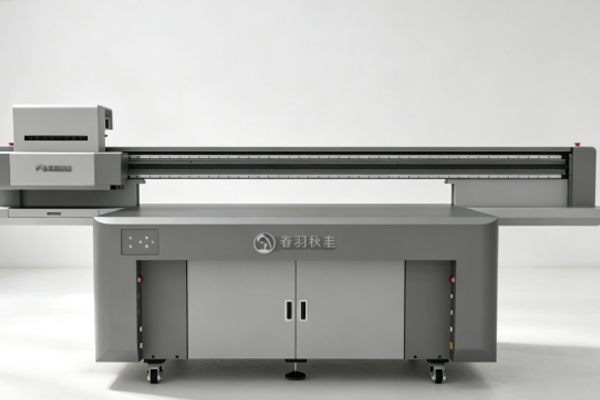
For companies engaged in advertising signage, packaging printing, home appliance panels, industrial manufacturing, and related industries, a UV flatbed conveyor printer must not only deliver excellent image quality but also provide stable, continuous, and highly efficient production capacity. When purchasing equipment, many businesses focus only on printing speed while overlooking other key factors that affect overall output. In fact, the efficiency of a UV flatbed conveyor printer is not determined by a single parameter, but by the combined effect of equipment performance, printing parameters, material compatibility, process workflow, and daily management. Only by systematically optimizing these factors can companies truly improve order delivery efficiency and overall competitiveness.
Equipment Performance Determines the Foundation of Production Efficiency
The hardware capability of the machine itself often determines the upper limit of a UV flatbed conveyor printer’s production efficiency. This is reflected not only in printing speed, but also in whether the equipment can run stably for long periods, whether it is easy to maintain, and whether it is suitable for continuous batch production.
Printhead Configuration Directly Affects Output Speed
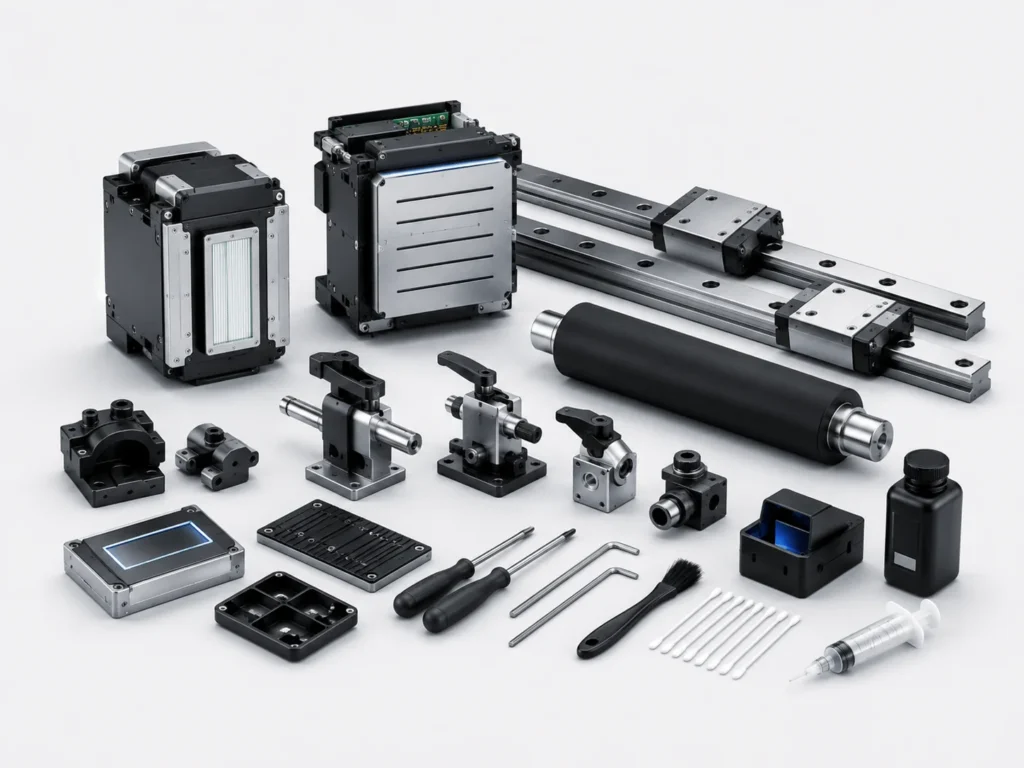
In the entire system of a UV flatbed conveyor printer, printhead configuration is usually the first core factor that determines production capacity, because it directly affects how much effective printing area can be completed per unit of time.
- The more printheads there are, the larger the printing area that can usually be covered per unit of time, giving batch orders a clear advantage in overall output speed.
- Printhead precision affects not only image detail performance, but also the balance between speed and print quality. Companies need to choose the right configuration based on product positioning.
- High-performance printheads are more suitable for long-term continuous operation because they are usually more stable under heavy workloads and less likely to affect production rhythm due to frequent shutdowns.
- Stable printhead operation can significantly reduce maintenance and cleaning time, allowing the machine to spend more time on actual printing and improving effective output.
A well-designed printhead configuration not only improves printing speed, but also ensures stable output under heavy workloads, preventing printhead issues from delaying the progress of an entire batch order.
Machine Structure Affects Continuous Operation Capability
Whether a UV flatbed conveyor printer is suitable for high-efficiency production depends not only on whether it can print, but also on whether it can maintain a stable rhythm and low failure rate during long-term operation.
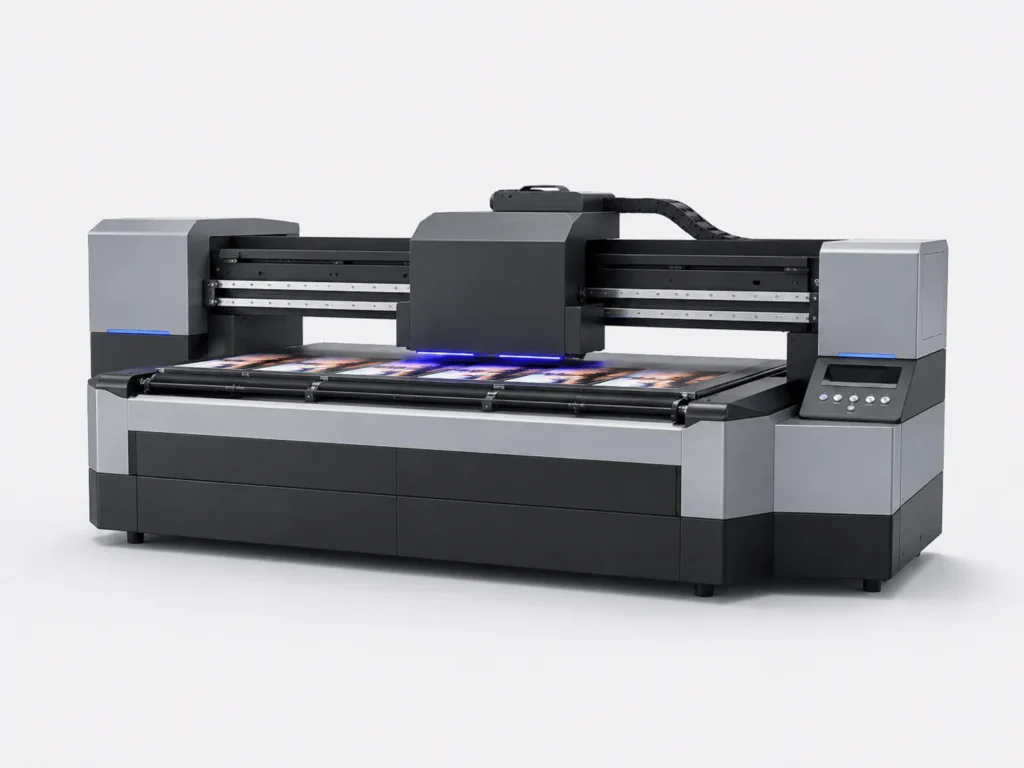
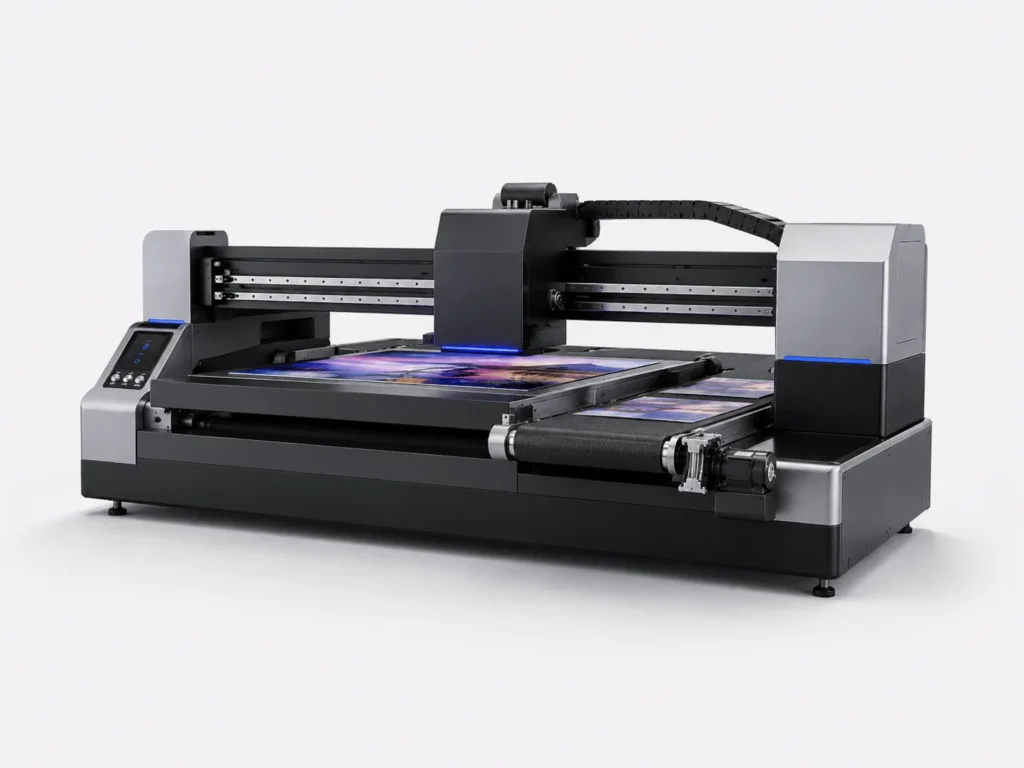
- The flatbed conveyor structure is more suitable for continuous automatic feeding because it allows materials to enter the printing area at a stable pace, reducing time loss caused by manual handling.
- High-precision guide rails help maintain smooth movement, effectively reducing deviations and vibrations during long-term high-speed printing.
- An automatic positioning system improves printing consistency, making the position and registration of each batch more uniform while reducing repeated calibration time.
- An intelligent control system reduces manual intervention, making the operation process smoother and helping minimize the impact of human error on efficiency.
A stable mechanical structure can effectively reduce operational errors, allowing the machine to maintain higher efficiency during long production runs and making it better suited for multi-batch, fast-paced order demands.
Printing Parameters and Curing Systems Affect Output Performance
Whether printing parameters are set properly directly determines whether a UV flatbed conveyor printer can fully realize its performance, while whether the curing system can keep up with the printing rhythm directly affects the continuity of the entire production line and final delivery efficiency.
Printing Mode and Resolution Settings Must Be Reasonable
Different orders have different requirements for quality and speed, so printing parameters should not remain fixed. Instead, they should be adjusted flexibly according to the actual product and delivery requirements.
- High-resolution mode is suitable for premium printing and products with high detail requirements because it better presents image layers and text edges, but the printing speed will usually be lower.
- High-speed mode is more suitable for batch production and standard orders. While maintaining basic image quality, it can significantly increase output per unit of time.
- Flexibly switching printing parameters according to product use allows companies to quickly adjust production strategies between different orders and avoid resource waste.
- Avoid blindly pursuing the highest resolution at the expense of efficiency, because overly high parameter settings often increase printing time without necessarily bringing matching commercial value.
If the parameters are not set properly, even a machine with good performance may experience slower speed, ink waste, or unstable image quality. Therefore, a balance must be found based on actual orders.
Ink Curing Speed Determines Production Rhythm
The reason a UV flatbed conveyor printer can achieve rapid forming largely depends on whether the curing system can keep up with the printing rhythm, and this is also a key efficiency factor that many companies tend to overlook.
- LED curing speed affects continuous printing capability. If the curing stage cannot keep up with the printing rhythm, material buildup and production waiting are likely to occur.
- The compatibility between ink and the curing system determines the final result. Only when both work in coordination can high production speed be maintained while ensuring adhesion.
- Stable curing reduces rework and scrap because insufficient curing may later cause fading, sticking, or uneven surfaces.
- Synchronized printing and curing are more conducive to improving efficiency, allowing the entire process to form a continuous rhythm and reducing idle time between stages.
A good curing system can shorten waiting time and make printing, curing, and unloading flow more smoothly, thereby improving overall output.
Material Compatibility and Process Workflow Are Equally Critical
Whether materials and workflow are properly matched often determines the stability of a UV flatbed conveyor printer in actual production. This stability directly affects whether the machine needs frequent adjustments, whether rework is likely, and whether the entire production line can maintain continuous and efficient operation.
Material Characteristics Affect Printing Efficiency
In actual production, different materials vary in surface condition, thickness, flatness, and ink absorption, all of which affect the efficiency of a UV flatbed conveyor printer. Material selection should not be based on cost alone, but also on compatibility. Flat and uniformly sized materials are more suitable for continuous printing and automatic feeding, reducing positioning deviations and setup time; materials with good surface adhesion are easier to ensure proper ink layer performance and reduce rework; the higher the compatibility between material and machine, the smoother the production process and the easier it is to maintain consistent finished product quality.
Front-End and Post-Processing Steps Must Be Well Coordinated
A highly efficient production line is not just about fast printing. More importantly, the front and back processes must connect seamlessly so that no stage slows down the overall rhythm.
- Reducing repeated handling and intermediate waiting time allows materials to move faster between processes, improving the overall production pace.
- Optimizing loading and unloading procedures reduces manual operation time and keeps the machine in an effective working state for longer periods.
- Arranging post-processing steps properly prevents production capacity from being wasted while waiting for finishing after printing.
- Completing file confirmation and layout preparation in advance reduces downtime caused by last-minute changes and makes production more efficient.
When pre-processing, printing, and post-processing are smoothly connected, the equipment utilization rate of a UV flatbed conveyor printer increases significantly, and the production line is more likely to remain stable.
Daily Management and Intelligent Optimization Improve Overall Efficiency
In addition to equipment and process, management level also affects final output. In many companies, the real difference is not the price of the machine, but whether they have established a standardized maintenance system, operating procedures, and digital management framework.
Equipment Maintenance and Operator Skills Cannot Be Ignored
Whether a UV flatbed conveyor printer can maintain high-efficiency operation over the long term depends not only on the hardware itself, but also on whether the company has established standardized maintenance and operating procedures. Regular cleaning of printheads and ink lines, inspection of guide rails and electrical components, keeping the equipment environment clean, and performing scheduled maintenance and calibration can effectively reduce failures and downtime. At the same time, if operators are familiar with the software workflow, can quickly complete layout import, correctly set parameters, and promptly handle abnormalities, production efficiency can be further improved while reducing rework and time loss.
Automation and Digital Management Further Increase Output
As manufacturing continues to upgrade, more and more companies are improving the efficiency of UV flatbed conveyor printers and reducing labor costs through automation and digitalization. Automatic positioning reduces adjustment time and improves printing accuracy; automatic feeding reduces manual operations and allows the machine to run more stably and continuously; continuous printing is suitable for multi-batch and repeat orders, helping improve equipment utilization; intelligent monitoring makes it easier for managers to check machine status, task progress, and abnormalities in real time. Digital management also improves order processing efficiency. Fast file import shortens preparation time, unified layout for multiple orders helps improve material utilization, and real-time production monitoring makes it easier to arrange delivery schedules and staffing. Through the combination of automation and digitalization, companies can arrange production more flexibly, improve order response speed, and better adapt to market changes.
The production efficiency of a UV flatbed conveyor printer is influenced by multiple factors, including equipment performance, printing parameters, material compatibility, process workflow, and daily management. Only by combining their own product characteristics and order requirements and scientifically optimizing equipment configuration and production processes can companies truly maximize the advantages of a UV flatbed conveyor printer and achieve high efficiency, high quality, and low-cost production. Springyprinter focuses on the research and manufacturing of industrial UV digital printing equipment and can provide customers with professional UV printing solutions and technical support services.