In today’s growing cylindrical product customization market, many businesses face a key question when choosing equipment: does a cylindrical printer require traditional plate-making like screen printing? This issue not only affects initial investment costs but also directly impacts production efficiency, order flexibility, and long-term operational strategy. Especially with the rapid growth of personalized products such as insulated bottles, cosmetic tubes, and wine bottles, whether “plate-making is needed” has become an important factor in equipment selection.
Core Principle of Cylindrical Printers: Is Plate-Making Required?
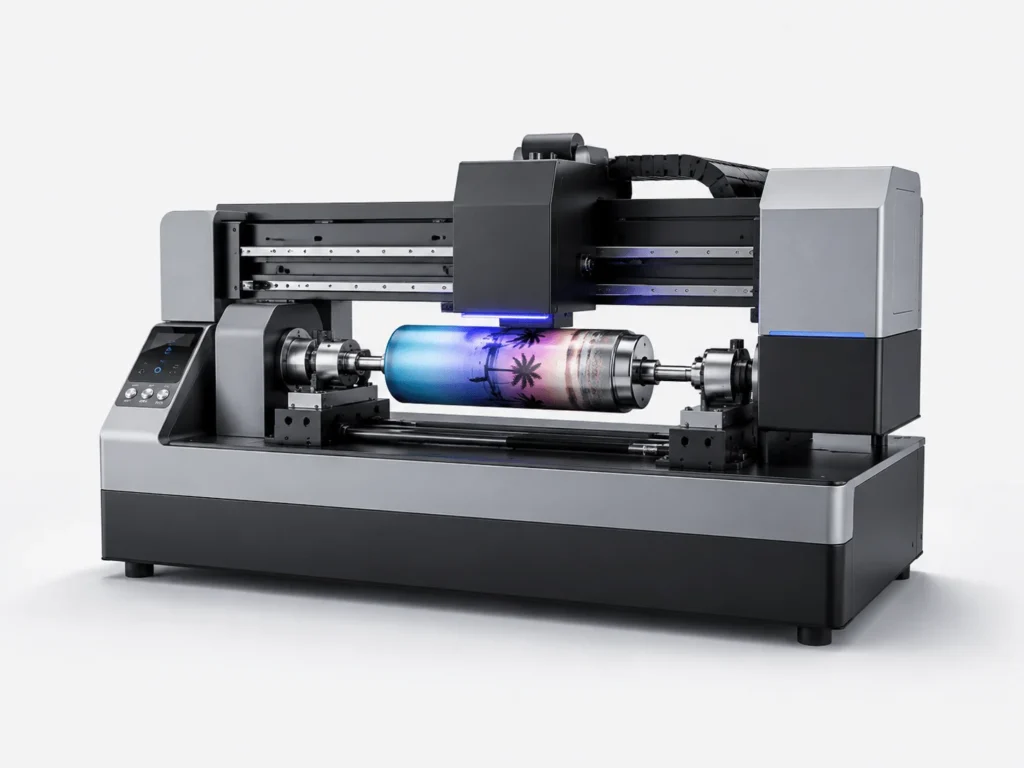
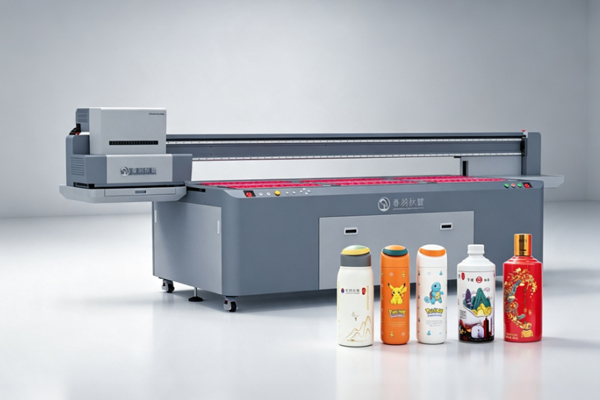
Before understanding whether a cylindrical printer requires plate-making, it is important to know how it works. Most cylindrical printers use UV digital inkjet technology, where digital design files directly control the print process, and UV light instantly cures the ink to form the final image.
In actual production, this process works as follows:
- The entire printing workflow is driven directly by digital files without any physical plates
- The printhead follows a precise programmed path to achieve 360-degree cylindrical printing
- UV curing systems instantly dry the ink, ensuring strong adhesion to the surface
- Design changes only require file updates, with no need for physical mold replacement
From a technical perspective, cylindrical printers are typical “plate-free digital printing devices,” completely different from traditional plate-based printing methods.
Advantages of Not Requiring Plate-Making
The absence of plate-making brings significant improvements in both efficiency and cost control, especially in small-batch and multi-order environments.
Key benefits include:
- Much shorter preparation time, allowing production to start immediately after file confirmation
- Flexible design modification without additional production steps
- Faster order switching, improving scheduling efficiency
- Rapid sampling for quick design validation
This model is particularly suitable for e-commerce customization, gift products, and fast-moving branded merchandise, as it greatly improves order responsiveness.
Comparison with Traditional Screen Printing
To better understand cylindrical printers, it is useful to compare them with traditional screen printing.
Screen printing characteristics:
- Requires mesh or metal plate preparation before production
- Each design corresponds to a dedicated physical plate
- Any design change requires new plate-making, increasing lead time
- More suitable for large-scale production of fixed designs
Cylindrical printer characteristics:
- No physical plate required; prints directly from digital files
- Designs can be modified at any time without production limitations
- Ideal for multi-SKU, small-batch, and fast delivery orders
- Relies on software and machine precision for output quality
In terms of production logic, one is based on physical replication, while the other is based on digital output.
Cost Impact of a Plate-Free System
Whether plate-making is required has a direct impact on cost structure, especially in complex order environments.
Cost advantages include:
- Lower initial investment, no repeated plate-making expenses
- More stable small-batch pricing without plate cost allocation
- Near-zero cost for design changes, improving product iteration speed
- Equipment investment becomes the main cost factor rather than recurring consumables
However, it is also important to note:
- Ink consumption and maintenance remain ongoing costs
- In extremely large-scale single-design production, unit cost may not be as low as screen printing
This makes cylindrical printers more suitable for diversified and flexible production models.
Ideal Scenarios for Plate-Free Cylindrical Printing
In real manufacturing environments, plate-free technology is not necessary for every situation. It performs best in the following cases:
- High SKU variety with frequent design changes
- Small-batch customized orders
- Fast sampling and quick delivery requirements
- Personalized gift and branded merchandise production
- E-commerce products with rapidly changing trends
In these scenarios, eliminating plate-making significantly reduces production delays and communication costs.
Is There a “Digital Plate” Concept?
Although cylindrical printers do not use physical plates, a similar concept exists in digital form.
Common examples include:
- Standardized design files for repeat production
- Print parameter presets such as resolution and ink density
- Material-specific configuration profiles
- One-click production workflows for batch orders
In essence, there is no physical plate, but there is a digital production template.
Overall, cylindrical printers do not require traditional plate-making, which is one of the key reasons they are so effective in modern customization markets. They transform printing from “physical plate preparation” to “direct digital output,” enabling greater flexibility and efficiency. This advantage is especially significant in multi-category and fast-changing order environments. SpringYprinter provides efficient and stable cylindrical printing solutions for modern businesses.