When purchasing UV LED ink, many people first look at the color and then compare the price. In most cases, standard color inks are priced similarly, while white ink, varnish, and spot color inks are generally more expensive. Different ink colors vary in terms of raw materials, manufacturing processes, and applications, so their prices are not always identical.The pricing of UV LED ink depends not only on its color but also on pigment costs, manufacturing complexity, product performance, and market demand.
Do Different Colors of UV LED Ink Cost the Same?
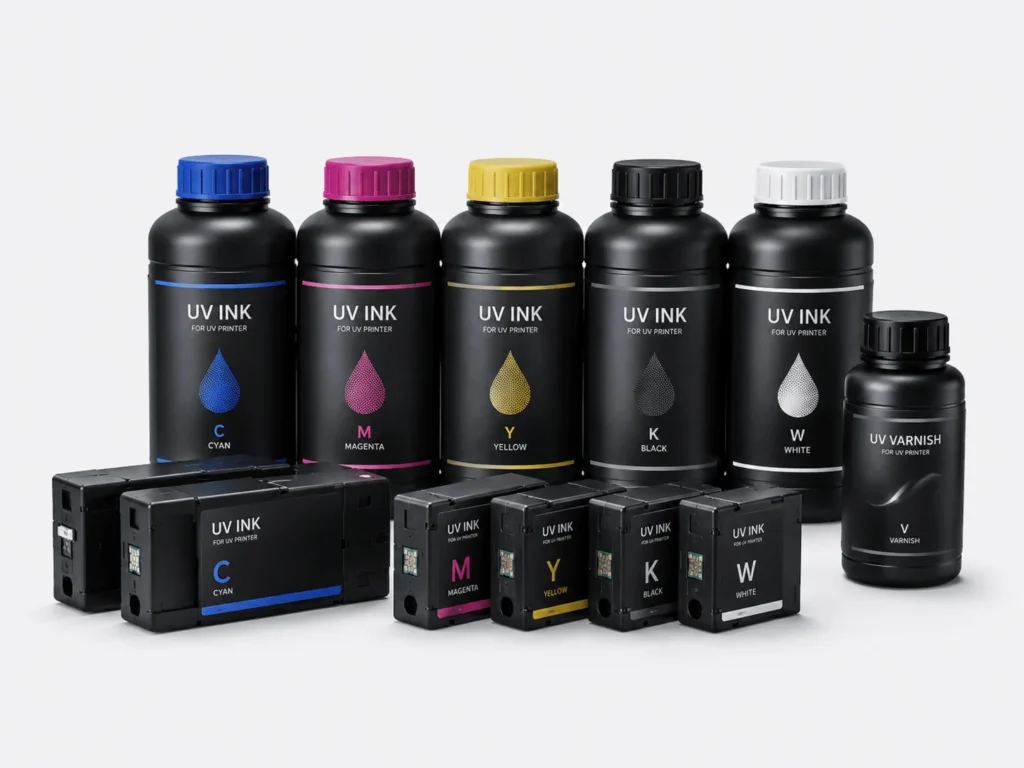
Under normal circumstances, standard UV LED ink colors are priced similarly. For example, the CMYK four-color set (Cyan, Magenta, Yellow, and Black) is typically sold at a uniform price, making purchasing and inventory management more convenient for both users and manufacturers.However, not all colors are priced the same. When it comes to white ink, varnish, spot colors, fluorescent inks, metallic inks, and other specialty products, prices are usually higher than those of standard CMYK inks due to differences in production costs, raw materials, and application requirements.Therefore, whether the prices are the same depends on the type of ink, brand, and intended application, rather than the color alone.
Why Do Different Colors of UV LED Ink Have Different Prices?
During the purchasing process, pricing is influenced by more than just color. Pigment selection, manufacturing processes, and market demand all play important roles. The following are some of the most common reasons.
● Different Pigment Costs
Different colors require different pigments, and each pigment has its own manufacturing cost.For example, standard black ink uses carbon black pigment, which has a mature production process and abundant supply, making it relatively inexpensive.By contrast, high-opacity white ink contains a large amount of high-quality titanium dioxide, which is significantly more expensive. As a result, white ink is often one of the highest-priced UV LED inks.Some vibrant colors also require weather-resistant organic pigments. To ensure long-term color stability and prevent fading, additional stabilizers are incorporated, further increasing production costs.
● White Ink Has Higher Manufacturing Requirements
White ink is not only more expensive but also requires stricter production and quality control.Since white pigment particles are relatively heavy, poor dispersion can lead to sedimentation and printhead clogging. Manufacturers therefore add specialized dispersants, anti-settling agents, and stabilizing formulations to maintain excellent flowability and printing performance.These additional manufacturing processes increase production costs, making white ink generally more expensive than CMYK inks.
● Specialty Colors Are Customized Products
Many industries require custom brand colors, corporate colors, or special decorative effects.
Examples include:Fluorescent colors、Metallic silver、Metallic gold、High-gloss clear varnish、Matte protective varnish.
Pantone® spot colorsThese products are usually manufactured in relatively small quantities based on market demand, and some require custom color matching. Consequently, their unit production costs are naturally higher.
● Market Demand Influences Pricing
Products with high sales volumes are manufactured in larger quantities, allowing manufacturers to benefit from economies of scale when purchasing raw materials, resulting in relatively stable pricing.Standard CMYK inks are purchased by almost every UV printing business, enabling continuous mass production and lower manufacturing costs.Specialty colors, however, have smaller market demand and slower inventory turnover. Manufacturers must carry higher inventory costs to maintain supply, which often results in slightly higher selling prices.
Pricing by Ink Type
CMYK Four-Color Ink:
CMYK represents the most common standard color set.Because these four colors are produced in large quantities and compete in a mature market, most manufacturers sell them at a uniform price.They are also the most cost-effective option for applications such as advertising production, packaging printing, acrylic printing, and PVC board printing.
White Ink:
White ink is generally one of the more expensive ink types.In addition to its higher pigment costs, white ink requires excellent adhesion, opacity, and long-term stability because of its frequent use. As a result, manufacturers invest more in research and development.
Many suppliers therefore price white ink separately rather than including it with standard CMYK pricing.
Varnish:
Although varnish is colorless, it is considered a functional ink.It enhances gloss, scratch resistance, water resistance, and three-dimensional visual effects. Because its formulation differs from ordinary colored inks, varnish is generally priced slightly higher than standard colors.
Special Effect Inks:
Fluorescent, glow-in-the-dark, pearlescent, and metallic inks require specialized pigments and manufacturing processes.These products are mainly used for premium packaging, decorative materials, craft gifts, and personalized customization, making them significantly more expensive than conventional inks.
Frequently Asked Questions
Why Is There Such a Large Price Difference Between White Inks From Different Brands?
Different manufacturers use pigments with varying purity levels, resin formulations, dispersion technologies, and filtration processes.Higher-priced products generally offer better jetting stability, lower printhead clogging rates, and longer storage life. Therefore, purchasing decisions should consider not only price but also print quality and service life.
Does Lower-Priced Color Ink Mean Lower Quality?
Not necessarily.Many standard color inks have lower manufacturing costs because of high market demand and large-scale production.As long as the ink comes from a reputable manufacturer and is compatible with the intended printing equipment, it can still provide excellent color performance and strong adhesion.
Do All Brands Price White Ink Separately?
Not all manufacturers follow the same pricing strategy.Some suppliers offer unified package pricing for convenience, while others quote white ink, varnish, and color inks separately.Before purchasing, it is recommended to review the product price list and confirm the specifications and capacities of each ink type.
Should You Always Choose the Lowest-Priced Ink?
Not necessarily.If an ink has poor flowability, weak adhesion, or frequently clogs printheads, its low purchase price may eventually result in higher maintenance costs, increased waste, and more equipment downtime.Considering factors such as printing efficiency, color consistency, and equipment maintenance costs often provides a more meaningful evaluation than comparing ink prices alone.
When choosing UV LED ink, there is no need to assume that every color should have exactly the same price.Standard CMYK inks are generally priced consistently because they are produced on a large scale. White ink, varnish, and various specialty colors naturally cost more due to differences in pigment costs, manufacturing processes, and application requirements.During the purchasing process, businesses should evaluate their printer model, printing materials, product applications, and production volume before making a decision.
For companies engaged in long-term continuous production, factors such as stability, adhesion, color consistency, and printhead compatibility are often more important than simply pursuing the lowest purchase price.High-quality, reliable inks help reduce printhead clogging, minimize rework, and maintain consistent color performance, ultimately improving customer satisfaction.Focusing only on the price of each bottle of ink can easily overlook the long-term costs associated with maintenance, consumable usage, and production efficiency. By comprehensively evaluating overall ink performance and selecting products that best suit specific business needs, companies can achieve better print quality and maximize the value of their investment.