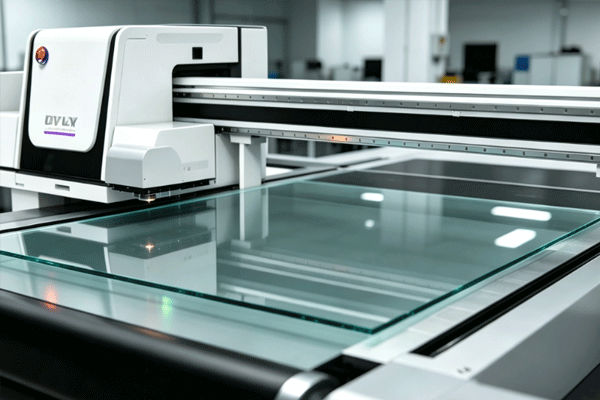
In the context of increasingly fierce competition in the modern home appliance industry, products must not only deliver functional advantages but also meet consumers’ aesthetic expectations in exterior design. In particular, for kitchen appliances such as ovens and microwave ovens, glass door panels have become an important showcase for brand differentiation. Traditional screen printing and film lamination processes are gradually unable to meet the demands of high precision, multiple patterns, and small-batch customization, while UV flatbed printing technology is becoming one of the mainstream solutions for color printing on glass panels. Through digital inkjet printing and instant curing technology, high-precision, heat-resistant, and scratch-resistant decorative effects can be achieved on glass surfaces, greatly enhancing product added value and brand image.
Process Characteristics and Challenges of Glass Panel Color Printing
Although the glass door panel seems to be only part of the appliance’s exterior, it actually places very high demands on the stability and durability of the printing process. Especially in kitchen environments, temperature changes, grease adhesion, and frequent cleaning will continuously test the pattern layer, so process selection should not only focus on visual effects, but also on long-term performance.
Higher Requirements for Heat Resistance and Durability
The oven glass door panel is exposed to long-term high temperatures, which places strict demands on the printing process. Only a process truly suitable for high-temperature scenarios can ensure stable appearance during long-term use.
- It must be heat-resistant and colorfast to avoid yellowing, darkening, or pattern distortion during prolonged baking.
- The ink layer must have strong adhesion to remain stable under alternating hot and cold conditions.
- It should not easily peel off or crack during long-term use, especially under the slight vibration caused by repeated opening and closing of the door panel.
- It must resist grease and cleaning agents to ensure a clear appearance after daily wiping.
Ordinary inkjet printing or film lamination processes are difficult to meet long-term stability requirements. Especially in high-end home appliances, exterior durability has become an important factor affecting brand reputation.
Smooth Surface Makes Adhesion More Difficult
Glass has a smooth surface and weak adhesion. If pre-treatment is not done properly, the ink layer may peel off or curl at the edges, and uneven flow may occur during printing, which places higher demands on printhead precision and curing performance. The key to glass color printing lies in the overall coordination of primer treatment, equipment precision, and process stability. Choosing a mature UV glass color printing solution is often more important than simply pursuing low cost.
Advantages of UV Flatbed Printing Technology in Glass Door Panels
Compared with traditional decorative methods, UV flatbed printing can more flexibly meet the home appliance industry’s dual requirements for appearance and efficiency. It is not only suitable for complex pattern output, but also better aligned with the current production rhythm of “small batches, multiple styles, and fast delivery.”
Direct Printing Enables High-Precision Pattern Reproduction
UV printing can be directly applied to glass surfaces. It allows design patterns to be transformed into actual product effects more quickly and accurately.
- No plate-making is required, saving the cumbersome pre-production preparation of traditional processes.
- It supports high-definition patterns and gradient effects, better presenting brand logos, decorative textures, and functional markings.
- It enables precise output of complex designs and brand visual elements to meet the differentiated needs of high-end products.
- It offers high image fidelity and strong color performance, especially suitable for kitchen appliances that emphasize texture and design.
For home appliance brands pursuing exterior upgrades, this direct digital output method not only improves design freedom but also helps products establish a more unified brand identity.
LED UV Curing Improves Adhesion and Durability
UV curing technology is one of the core advantages. It not only determines printing speed, but also directly affects how firmly the pattern adheres to the glass surface.
- Instant curing after printing improves production efficiency and reduces waiting time and contamination risk during handling.
- It strengthens the bond between the ink layer and the glass, making the pattern more firmly attached to the surface.
- It enhances scratch resistance and wear resistance, making it suitable for kitchen environments with frequent contact and cleaning.
- It is suitable for long-term high-temperature environments and better adapts to the actual use conditions of oven door panels.
This effectively solves the problem of easy peeling in traditional processes and upgrades glass door panel color printing from a “decorative process” to an industrialized solution that is mass-producible, deliverable, and durable.
Core Process and Technical Implementation of the Solution
To ensure stable implementation of glass door panel color printing, the three stages of pre-treatment, printing, and color layering must work together. Different process solutions also vary significantly in efficiency, cost, and results, so enterprises need to make comprehensive decisions based on their own capacity and product positioning.
| Comparison Item | Traditional Screen Printing / Film Lamination | UV Flatbed Printing Solution |
| Production Method | Requires plate-making or film application | Direct digital output |
| Suitable Orders | Large batches, fixed patterns | Small batches, multi-style customization |
| Pattern Performance | Limited color layering | Supports HD, gradients, and complex patterns |
| Production Efficiency | Slow changeover, long process | Fast switching, instant printing and curing |
| Adhesion & Durability | Easily affected by heat and cleaning | Better suited for high-temperature and wear-resistant needs |
This comparison also shows that UV flatbed printing is better suited to the current home appliance industry’s demand for flexible manufacturing and fast delivery. For companies that frequently update exterior designs and launch different product series, it is not only a process upgrade, but also a production model upgrade.
Surface Pre-Treatment and Coating Optimization
Pre-treatment is the key step to ensuring print quality. Only when the glass surface is properly treated can the subsequent printing effect remain truly stable.
- Apply a special primer to enhance adhesion and make the ink layer bond more firmly to the glass surface.
- Remove grease and dust from the glass surface to prevent impurities from affecting print uniformity and pattern integrity.
- Control surface tension to improve ink adhesion and reduce issues such as ink shrinkage, broken lines, and localized peeling.
- Ensure uniformity in the printing area to lay the foundation for high-precision output.
Good pre-treatment directly determines the quality of the final product. Many glass color printing failures are not caused by equipment problems, but by unstable adhesion due to inadequate pre-treatment, so this step must be standardized and systematized.
Multi-Layer UV Printing and Color Layering Technology
UV printing supports multi-layer structure output. Through the combination of different ink layers, the glass door panel can present richer visual depth.
- CMYK + white ink enhances visual effects, allowing clear patterns even on dark glass surfaces.
- It can create semi-transparent and three-dimensional effects, improving the decorative layering and premium feel of the door panel.
- Multi-layer stacking enhances pattern texture, suitable for brand logos, functional division lines, and decorative textures.
- It meets the needs of high-end custom design, making the product more recognizable in appearance.
This is suitable for upgrading the exterior of high-end kitchen appliances. For enterprises that emphasize design language and brand tone, multi-layer printing not only improves visual performance but also helps products attract consumer attention more quickly in the terminal market.
Advantages in Production Efficiency and Cost Optimization
For manufacturers, a color printing solution must not only look good, but also help improve efficiency and reduce costs. A truly valuable process must simultaneously consider order response speed, material utilization, and overall operating costs.
Small-Batch Customization Lowers Production Barriers
UV printing is suitable for diverse order requirements. It allows enterprises to arrange production more flexibly when facing different customers and different product models.
- No mold opening is required, reducing upfront investment and design trial-and-error costs.
- Supports one-piece orders, suitable for new product trials, sample production, and personalized orders.
- Quickly switches between different designs to meet flexible production needs for multiple models and series.
- Reduces inventory pressure and avoids finished goods accumulation caused by fixed patterns.
It is especially suitable for the rapid iteration of home appliance brand designs. In a market environment where new product launch cycles are becoming shorter, processes that can respond quickly to market changes are more likely to create competitive advantages.
Automated Production Improves Overall Efficiency
High automation makes it suitable for industrial production. This is especially important for factories pursuing stable delivery and large-scale output.
- Reduces manual operation steps, lowering human error and repetitive labor intensity.
- Increases output per unit time, allowing equipment to maintain higher utilization in continuous production.
- Reduces labor costs, especially suitable for factory scenarios requiring long-term stable operation.
- Improves production stability and reduces quality fluctuations caused by operational differences.
Suitable for large-scale manufacturing enterprises. For factories seeking both efficiency and quality, automated UV printing solutions can not only improve line efficiency but also help establish more stable delivery capabilities.
Application Scenarios and Future Development Trends
As home appliances continue to move toward high-end, intelligent, and personalized directions, the application space for glass door panel color printing is also expanding. In the future, exterior design will no longer be just an add-on, but an important part of product competitiveness.
The Trend Toward High-End Appliance Exterior Upgrades Is Obvious
Glass panels have become a key point of brand differentiation. More and more brands are treating door panel design as a product selling point.
- Oven, microwave, and dishwasher panels are all moving toward more refined visual design.
- Smart appliance touch glass decoration increasingly emphasizes the integration of patterns and functional areas.
- High-end kitchen overall design stresses a unified style, and door panel printing has become part of the visual extension.
- Brand visual identity upgrades are driving products from a “function-oriented” to an “experience-oriented” approach.
Exterior design has become one of the core competitive advantages. When consumers choose home appliances, they are often first attracted by appearance and then pay attention to functional specifications, so the value of color printing processes is continuously increasing.
Personalization and Smart Manufacturing Drive Industry Upgrades
Future trends are leaning more toward customized production. Whoever adapts faster to this change will be more likely to gain an advantage in the market.
- The demand for small-batch, multi-style production is growing, and traditional fixed processes are becoming increasingly difficult to adapt.
- Smart factory flexible manufacturing is upgrading, requiring equipment with higher compatibility and responsiveness.
- Rapid design iteration has become the norm, and product update cycles are continuously shortening.
- UV printing is becoming one of the standard processes, gradually entering more home appliance manufacturing stages.
The industry is rapidly moving toward digitalization. Whoever can achieve flexible production, fast delivery, and stable quality more quickly will have a better chance of taking the lead in competition.
The oven glass door panel color printing solution is not only an upgrade in decorative technology, but also an important driver for the home appliance manufacturing industry’s move toward high-end and personalized development. Through UV flatbed printing technology, enterprises can achieve high-precision pattern output and flexible customized production while ensuring heat resistance and high durability, thereby significantly enhancing product competitiveness and market appeal. Springyprinter specializes in the R&D and manufacturing of industrial UV digital printing equipment and can provide customers with professional glass panel color printing solutions and technical support services.