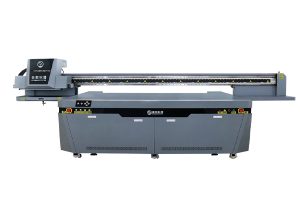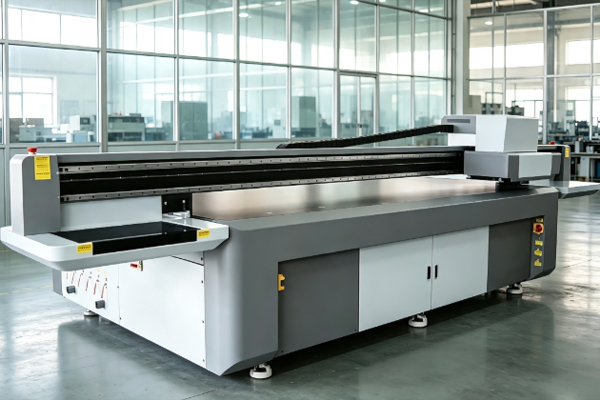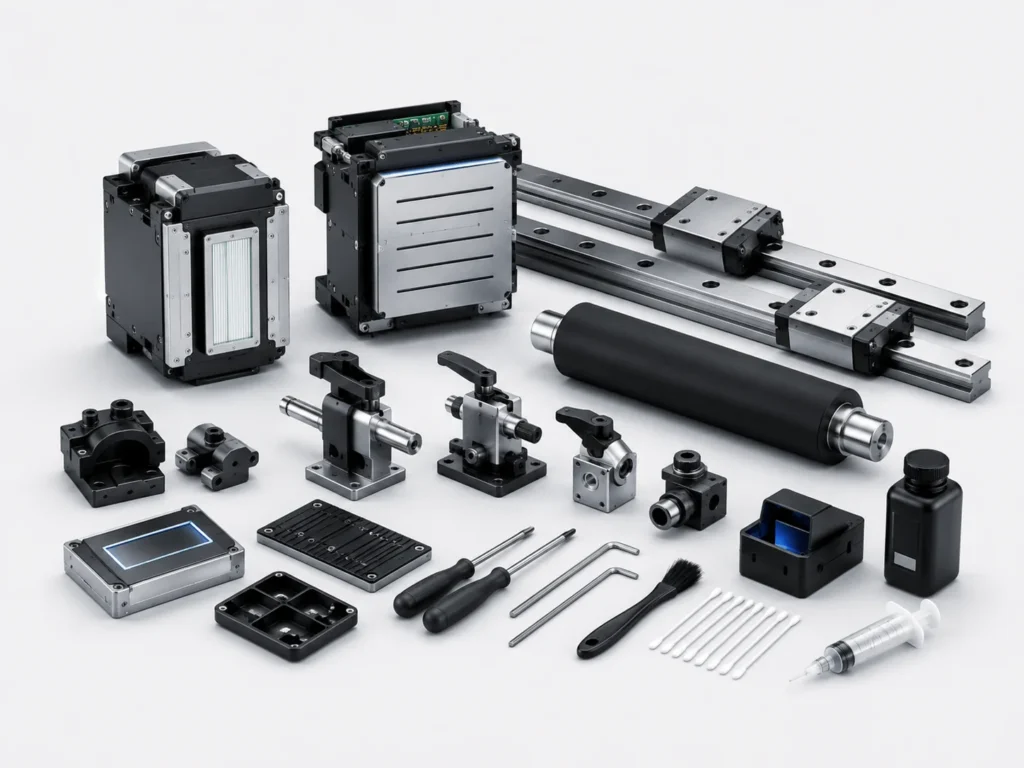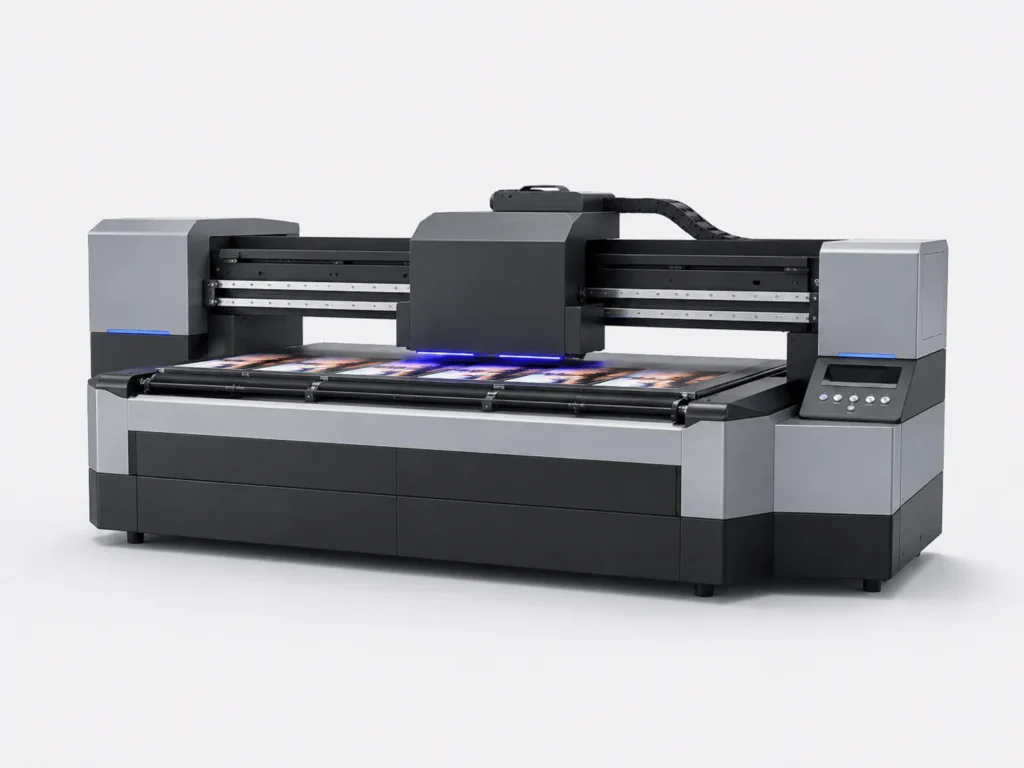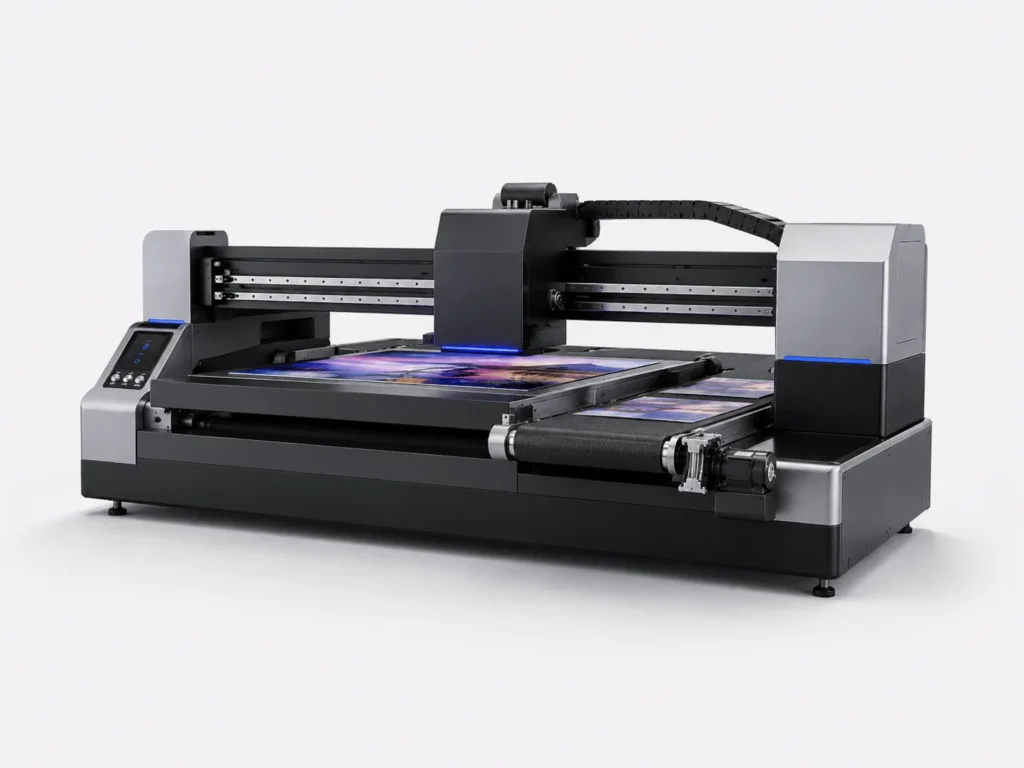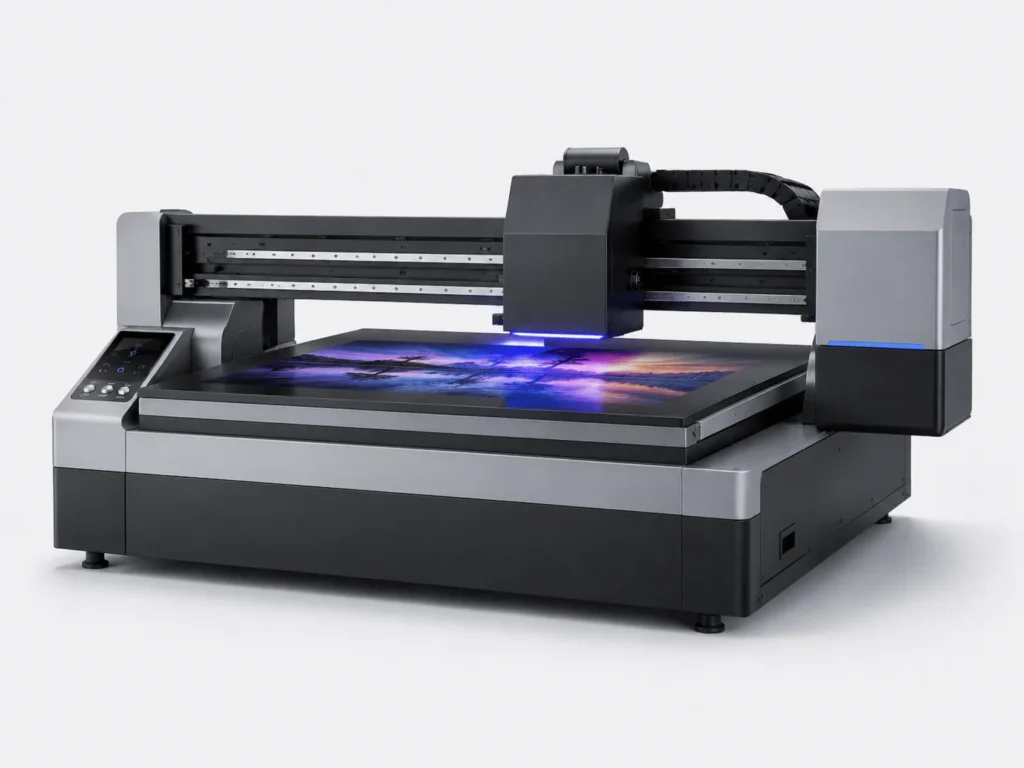
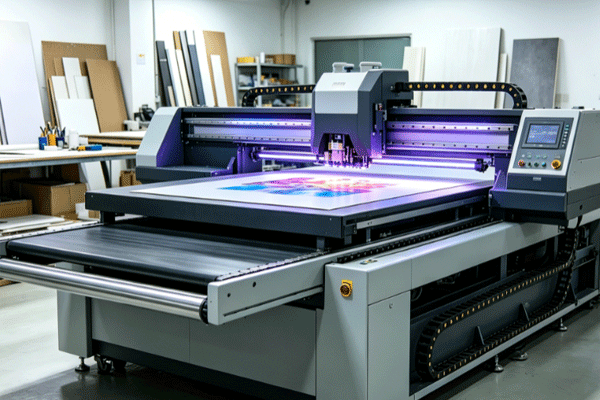
Against the backdrop of rapid growth in industrial digital printing, UV flatbed conveyor printers have gradually become important production equipment in packaging, advertising, decorative materials, and personalized customization fields. Compared with traditional flatbed UV machines, they use a combined “flatbed + conveyor belt” structure to achieve more efficient continuous production. When many companies purchase equipment, they often focus more on price and output capacity, but what truly determines equipment stability and output quality is its internal core component system. Understanding these core structures not only helps with equipment selection, but also enables companies to better manage production and control costs.
Printhead System: The Core That Determines Image Quality
The printhead system is the foundation of the entire machine’s output performance and the most direct factor affecting finished product precision. Whether it is small text, gradient patterns, or highly saturated color images, all of them rely on the printhead for accurate ink ejection. Therefore, it can be said to be the most critical “output organ” of a UV flatbed conveyor printer.
Printhead Type and Printing Precision
The printhead is one of the most important components of a UV printer, and different printhead types directly affect the machine’s positioning, speed, and imaging performance.
- Common industrial printheads include Ricoh, Epson, and Konica, each with its own characteristics in ejection frequency, durability, and application scenarios.
- They determine printing resolution and detail performance, especially affecting the reproduction of small text, lines, and complex patterns.
- They influence gradient transitions, text clarity, and image sharpness; the more stable the printhead, the sharper the image edges and the more natural the tonal transitions.
- Different printheads are suitable for different production needs, and companies need to match them according to order type, production scale, and budget.
- Industrial printheads are more suitable for long-term continuous operation and can meet the needs of high-frequency factory production and batch delivery.
- High-precision printheads are more suitable for orders with high detail requirements, such as premium packaging, decorative panels, and customized gifts.
Generally speaking, the more stable the printhead, the clearer the image edges and the more even the color blocks. Especially in premium packaging, decorative panels, and customized products, printhead performance often directly determines the customer’s first impression of the finished product. For companies, choosing the right printhead is not just about specifications, but also about matching order type, production demand, and maintenance cost.
Ink Droplet Control and Stability
The printhead affects not only clarity but also stability. A truly excellent printhead system must not only “print clearly,” but also “print continuously and stably.”
- Ink droplet size affects color delicacy; the more precise the droplets, the richer the image layers and transition effects.
- Multi-level grayscale control enhances depth and layering, making shadows, gradients, and highlights more natural.
- Stable ejection reduces missing-line issues and avoids gaps, broken lines, or incomplete color blocks in the pattern.
- Long-term running stability is crucial, especially in batch production, where printhead condition directly affects the efficiency of the entire production line.
- More precise droplet control leads to smoother image transitions and a finished product that more closely matches the original design.
- Stable printhead performance reduces rework and downtime, thereby lowering material waste and manual repair costs.
In actual production, unstable ink droplet control can easily cause ink splatter, missing lines, ghosting, and other issues, which not only affect product quality but also increase material waste and manual rework costs. High-quality printheads combined with a proper maintenance mechanism can significantly improve continuous operation capability, making them especially suitable for batch orders and high-frequency production scenarios.
Conveyor System: The Key Structure for Continuous Production
The conveyor system determines whether the machine can efficiently and stably complete batch tasks, and it is also an important feature that distinguishes conveyor-type machines from ordinary flatbed equipment. It not only handles material transport, but also directly affects printing rhythm, positioning accuracy, and production efficiency. It is an important reflection of the machine’s automation level.
Conveyor Belt and Feeding Mechanism
The conveyor structure is an important feature of this machine, allowing materials to automatically enter the printing area at a set pace and enabling continuous production.
- Automatically transports materials into the printing area, reducing the time spent on manual handling and repeated placement.
- Supports continuous batch production, suitable for factory orders requiring long operating hours.
- Reduces manual loading and unloading operations, making the workflow easier and more labor-saving.
- Improves overall production efficiency, allowing the machine to complete more tasks in less time.
- Suitable for a variety of flat materials such as boards and sheets, offering a wider application range than ordinary equipment.
- Can be adjusted according to material thickness to ensure smooth passage of different materials through the printing area.
Compared with traditional single-sheet flatbed machines, the biggest advantage of the conveyor system is time savings. Operators do not need to move materials frequently or reposition them each time, and the machine can complete multiple batches in a shorter period. For factories with large order volumes and tight delivery schedules, this continuous feeding capability can significantly improve production capacity utilization.
Positioning and Correction System
Precision depends on the conveyor control system. Especially at high operating speeds, positioning and correction capabilities directly determine whether the pattern can be placed accurately. The system can automatically detect material position, prevent deviation and misalignment, ensure consistency across batches, and reduce waste caused by running off track. If the conveyor system lacks precise correction functions, materials may shift, tilt, or move at inconsistent speeds during transport, ultimately causing inaccurate pattern placement or even scrapping an entire batch. A high-level positioning system allows the machine to maintain stable output during long-term operation, making it especially suitable for industrial applications with high repeatability requirements.
UV Curing System: The Key to Drying Efficiency and Adhesion
The UV curing system directly determines whether the ink can form quickly and also affects the durability and surface performance of the final product. Its role is not only to “dry the ink,” but more importantly to cure the ink layer in a very short time, ensuring that printing speed and finished product quality improve simultaneously.
LED UV Lamp Structure
The UV curing system determines ink formation speed and is an important guarantee for high-speed printing.
- LED UV lamps instantly cure the ink, allowing the pattern to set quickly after printing.
- Energy-saving and long-lasting, reducing long-term power consumption and replacement costs.
- Controls curing intensity for different materials, adapting to glass, metal, acrylic, wood panels, and more.
- Supports high-speed printing rhythms, allowing the machine to work better with the continuous conveyor system.
- Generates relatively low heat, making it more suitable for precision printing and reducing the risk of material deformation from heat.
- The exposure effect can be adjusted according to ink layer thickness to ensure full curing of different layers.
Compared with traditional curing methods, LED UV lamps offer advantages such as fast response, low energy consumption, and long service life, making them especially suitable for industrial continuous production. They can cure the ink immediately after it is sprayed, preventing pattern spreading or trailing while also reducing waiting time so the machine can move more quickly into the next printing cycle. For companies pursuing efficiency, this system directly affects production output.
Curing Uniformity and Adhesion
Curing quality determines product durability and is also an important standard for judging whether a UV-printed product is qualified.
- Uneven curing affects color stability, causing local darkening, whitening, or inconsistent gloss.
- It affects ink layer adhesion; if adhesion is insufficient, the print may peel off during later use.
- It determines scratch resistance and waterproof performance, directly affecting product performance during transport and use.
- It affects the final service life; the more stable the curing, the better the product can withstand long-term environmental exposure.
- Weak curing can easily cause fading or delamination, affecting customers’ evaluation of product quality.
- Excessive curing may also affect the surface effect of the material and even cause some materials to lose their original texture.
If curing is uneven, the finished product surface may show local stickiness, whitening, or insufficient adhesion, making it more likely to be damaged during transport, installation, or use. For applications such as packaging, advertising boards, and decorative panels, curing performance directly affects market reputation. Therefore, a stable and uniform UV curing system is an indispensable part of industrial-grade applications.
Control System, Machine Structure, and Ink Supply System: The Foundation of Stable Operation
The control system and machine structure together determine whether the equipment can operate stably over the long term, while the ink system directly affects color performance and maintenance costs. Although these three modules belong to different parts, they work together in actual production and are indispensable foundational components.
Control Software and Frame Structure
The software system is the “brain” of the machine, while the machine structure is the foundation of stable operation. Together, they determine the machine’s intelligence level and operational reliability. The control system is responsible not only for printing paths and color management, but also supports multi-task layout, remote operation, and automated production, helping companies reduce human error and improve efficiency. Meanwhile, the high-strength frame can effectively reduce vibration, ensure printing precision and long-term continuous operation stability, and also help with production data management and task scheduling.
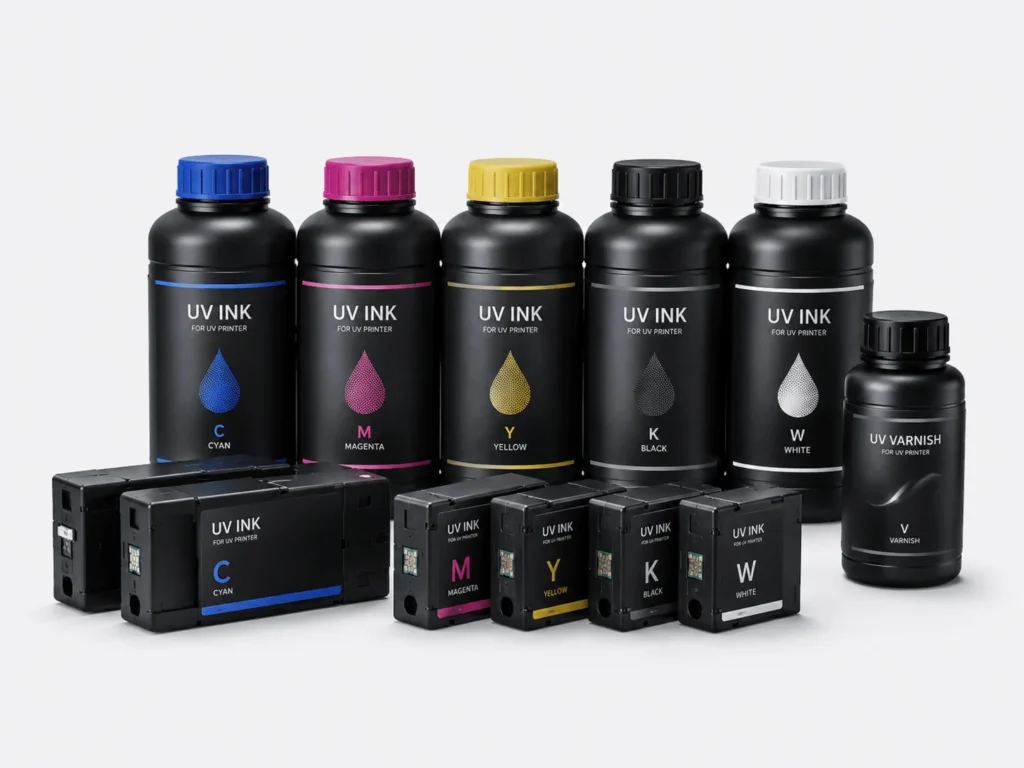
UV Ink and Ink Circulation System
The ink system not only determines color performance, but also affects equipment maintenance frequency and overall production cost, making it an important factor in long-term operations.
- The CMYK + white + varnish multi-color system can meet the printing needs of different materials and visual effects.
- Supports adhesion to a variety of materials, allowing the machine to be used in more industries and product types.
- High color saturation delivers brighter and more layered image effects.
- Automatic ink supply reduces manual intervention, making production more continuous and stable.
- Prevents ink interruption and nozzle clogging, reducing downtime caused by ink path issues.
- Improves long-term operational stability, especially in high-frequency, large-scale industrial production environments.
- Helps reduce consumable waste, allowing companies to control operating costs while maintaining quality.
The formulation and stability of UV ink directly affect the color layering, adhesion, and surface texture of printed products. Especially in white ink and varnish applications, the stability of the ink supply system is even more critical, because once clogging, ink interruption, or circulation problems occur, the efficiency of the entire production line will be affected. A well-designed ink circulation system keeps the ink path unobstructed, reduces maintenance frequency, and lowers hidden costs caused by downtime.
The reason UV flatbed conveyor printers are widely used in industrial production is that they are composed of multiple key modules working together, including the printhead system, conveyor system, UV curing system, control system, machine structure, and ink supply system. These systems jointly determine the machine’s printing precision, production efficiency, and stability. For companies, understanding these core components not only helps them choose more suitable equipment, but also enables them to achieve higher efficiency and lower operating costs in actual production, thereby improving overall competitiveness. Springyprinter focuses on the R&D and manufacturing of industrial digital printing equipment and can provide customers with professional UV printing solutions and technical support services.