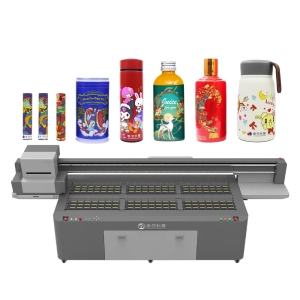
With the rapid development of digital manufacturing, UV printers have become essential equipment in advertising, packaging customization, and industrial production. Unlike traditional printing methods, UV printers do not require plate-making and can directly print on a wide range of materials with high precision. This makes them widely used in the personalized customization market. However, many users still wonder: how does a UV printer actually work? How can it print directly on glass, metal, plastic, and other materials while achieving fast curing and high-quality results? Understanding its working principle helps users better operate the equipment and evaluate its applications.
Basic Workflow of a UV Printer
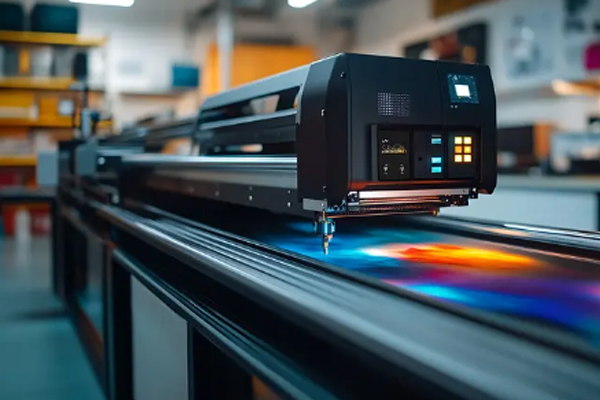
The core principle of a UV printer can be understood as a combination of “inkjet printing + UV curing.” The entire process is a continuous and synchronized system rather than simple ink spraying.
In actual operation, the workflow is as follows:
- The design file is processed by RIP software on a computer
- The printhead sprays ink precisely onto the material surface
- UV lamps instantly cure the ink using ultraviolet light
- The image is quickly formed and fixed on the surface
Unlike traditional inkjet printing, UV printers cure ink immediately during printing. The ink does not spread or penetrate, ensuring sharp edges and stable colors.
This allows UV printers to print directly on non-absorbent materials such as glass, metal, and acrylic—something traditional printing methods cannot easily achieve.
How the Inkjet System Achieves High Precision?
The print quality of a UV printer mainly depends on the inkjet system, which determines sharpness, detail performance, and color accuracy.
The inkjet system includes:
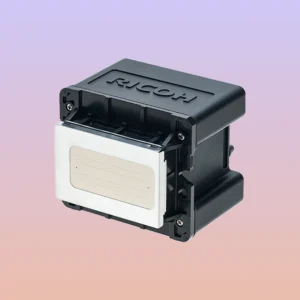
- Industrial printheads
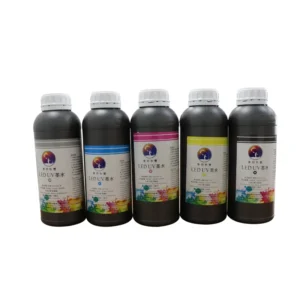
- Ink supply system
- Precision guide rail structure
- Control system
The printhead controls the size and placement of ink droplets, enabling high-resolution output. Smaller droplets result in finer details.
During operation:
- The printhead sprays ink point by point according to the design path
- The guide rail ensures stable movement
- Multi-channel printing mixes different colors
- Software ensures accurate image positioning
This precise control enables photo-quality printing, where even small text and gradients are clearly reproduced.
The Key Role of the UV Curing System
The biggest difference between UV printers and standard inkjet printers lies in the UV curing system, which determines both efficiency and adhesion.
The UV curing system uses ultraviolet lamps to:
- Expose ink immediately after spraying
- Trigger rapid photopolymerization of the ink
- Bond ink firmly to the material surface
- Prevent ink spreading or bleeding
This instant curing process offers several advantages:
- No drying time required after printing
- Stronger scratch resistance
- Printable on smooth or non-absorbent surfaces
- Supports continuous high-speed production
In industrial applications, this immediate curing capability significantly improves efficiency and enables mass production.
How Material Compatibility Is Achieved?
UV printers can work on many different materials due to the special properties of UV ink and curing technology.
Common printable materials include:
- Glass
- Metal
- Acrylic
- Plastic
- Wood
- Ceramic
To ensure printing quality on different surfaces, the system uses:
- White ink underbase to enhance color performance
- Surface pretreatment to improve adhesion
- Adjustable UV light intensity for different materials
- Multi-layer printing for 3D effects
For example, when printing on transparent glass, a white ink layer is required first to ensure colors appear vivid and not see-through.
This strong material adaptability makes UV printers widely used in packaging, gifts, and industrial marking.
Application Value and Future Development
With the growing demand for customization, UV printers are expanding into more industries and becoming an important part of digital manufacturing.
Main applications include:
- Advertising signage production
- Cosmetic packaging printing
- Tumblers and gift customization
- Industrial product labeling
- Creative merchandise production
Future development trends include:
- Higher precision printheads
- Faster printing speeds
- More eco-friendly UV inks
- Smarter control systems
These improvements will further enhance efficiency and reduce operational barriers, allowing more small and medium-sized businesses to enter the customization market.
The working principle of UV printers is essentially the integration of digital inkjet technology and UV curing, enabling high-precision and fast-forming printing. It not only transforms traditional printing methods but also drives the growth of customized manufacturing. SpringYprinter specializes in UV printer solutions, providing stable and efficient digital printing equipment for various industries.