In today’s rapidly developing packaging design, advertising production, and industrial customization industries, the choice of printing technology directly affects product visual quality and production efficiency. Traditional printing still plays an important role in large-scale production, but the emergence of UV printing is transforming the entire industry’s production model. More and more companies face the same question when upgrading their products: what is the difference between UV printing and traditional printing, and which one is more suitable for today’s customized market? Understanding these differences helps businesses find the optimal balance between cost, efficiency, and quality.
Fundamental Differences in Printing Principles
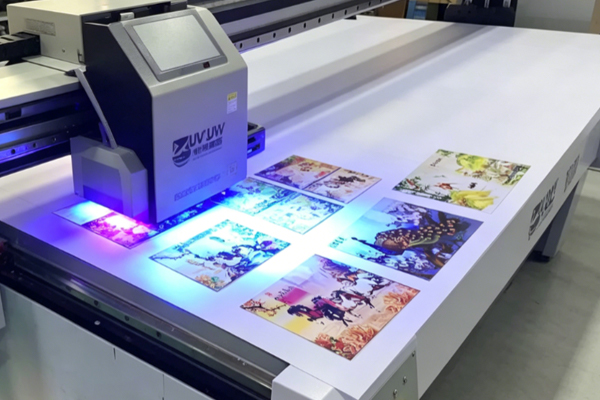
The biggest difference between UV printing and traditional printing lies in their working principles. UV printing uses an “inkjet + UV curing” process, where ink is sprayed onto the material surface and immediately cured by UV light to form the image. Traditional printing mainly relies on ink transfer or plate-based pressure printing to complete image output.
In detail:
- UV printing: ink is directly sprayed onto the surface and instantly cured by UV light
- Traditional printing: requires plates, with ink transferred onto materials
- UV printing: non-contact digital output
- Traditional printing: relies on physical plates and mechanical pressure
This fundamental difference determines that UV printing is better suited for digital, small-batch, and diversified production, while traditional printing is more suitable for standardized, large-scale production.
Differences in Production Efficiency and Flexibility
In actual production, the efficiency gap between the two methods is very obvious. UV printing does not require plate-making and can output directly, making it ideal for fast sampling and small-batch multi-design orders, while traditional printing is more suitable for large-volume standardized production.
UV printing features include:
- No plate-making required, direct printing
- Fast design switching, suitable for multi-SKU orders
- Lower cost for small-batch production
- Quick sampling with instant design modification
Traditional printing, on the other hand:
- Requires longer pre-press plate-making time
- Better suited for large-scale uniform production
- Higher cost when changing designs
- Not economical for small orders
For today’s e-commerce customization, brand collaborations, and personalized gift markets, UV printing clearly offers greater flexibility.
Material Compatibility Differences
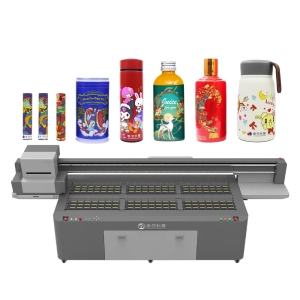
Material adaptability is another major difference between UV printing and traditional printing. UV printing can be applied directly to glass, metal, plastic, and many other materials, while traditional printing is usually limited to absorbent materials such as paper.
UV printing supports a wide range of materials, including:
- Glass
- Metal
- Plastic
- Acrylic
- Wood
- Ceramic
Its key advantage is that it does not rely on material absorbency, instead using UV curing to achieve adhesion.
Traditional printing is more limited:
- Mainly suitable for paper and cardboard materials
- Requires additional treatment for smooth or non-absorbent surfaces
- Often needs intermediate transfer processes
Therefore, UV printing is more widely used in industrial marking, gift customization, and high-end packaging.
Image Quality and Visual Performance
In terms of visual output, the two technologies also differ significantly. UV printing can achieve higher color saturation, finer image detail, and more diverse special effects.
UV printing advantages include:
- High color accuracy and reproduction
- Supports gradients and complex graphics
- Enables white ink and varnish effects
- Allows embossed and 3D visual textures
Traditional printing characteristics:
- More stable color performance in mass production
- Better for standardized color output
- Limited special effect capabilities
- Detail performance depends on screen dots and plate precision
Especially in high-end packaging, UV printing delivers richer visual layers, making products more attractive and premium.
Cost Structure and Long-Term Value Differences
From a cost perspective, the two methods follow completely different logic. UV printing requires higher initial equipment investment but eliminates plate-making, proofing, and plate-change costs, making it more suitable for small-batch and multi-category orders. Traditional printing has lower unit cost in large-scale production but high initial plate-making costs, making small orders less economical.
UV printing cost characteristics:
- No plate-making costs
- Significant advantage in small batches
- Higher equipment investment but strong flexibility
- Suitable for diversified order structures
Traditional printing cost characteristics:
- Fixed and relatively high plate-making costs
- Lower unit cost in mass production
- Suitable for long-term stable orders
- Disadvantageous for small orders
Therefore, UV printing is more aligned with today’s “fragmented orders + rapid iteration” market, while traditional printing still dominates large-scale standardized production.
Industry Application Trends
As market demand becomes more segmented, the application scenarios of UV printing and traditional printing continue to evolve. The former is more suitable for personalized, small-batch, and multi-material customization, while the latter still maintains advantages in large-scale standardized production.
UV printing is mainly used in:
- Personalized custom products
- Cosmetic packaging
- Gifts and creative products
- Industrial labels and panels
Traditional printing is widely used in:
- Newspapers and book publishing
- Large-scale paper packaging
- Standardized label production
Overall, the industry is shifting from mass production toward personalized and flexible manufacturing, and UV printing is expanding its application scope accordingly.
UV printing and traditional printing are not simply alternatives to each other but represent two different production solutions for different business models. In today’s market, UV printing is becoming the preferred technology for more companies due to its flexibility, multi-material compatibility, and fast production capability. SpringYprinter specializes in UV printing solutions, providing stable and efficient digital printing equipment for businesses.