In the highly competitive cosmetics industry, packaging is no longer just a container but a key touchpoint for brand communication and consumer perception. Especially for glass bottles, acrylic containers, and premium skincare packaging, there is an increasing demand for high visual quality, color consistency, and flexible production. Traditional printing methods such as screen printing and pad printing are gradually showing limitations when facing multi-SKU production, small-batch customization, and rapid product updates. As a result, UV flatbed printing technology powered by the UV flatbed printer is becoming an important alternative solution for cosmetic packaging production, offering brands a more flexible and efficient manufacturing approach.
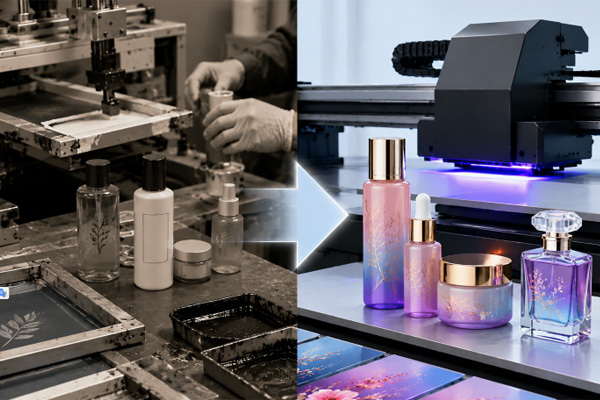
Limitations of Traditional Cosmetic Printing Methods
With the rapid segmentation of the cosmetics market, product packaging updates are becoming faster and more frequent. Although traditional printing technologies are mature and widely used, they struggle to meet modern production demands in terms of flexibility and efficiency.
Complex plate-making process and slow market response
Traditional screen printing and hot stamping require plate-making, color adjustment, and repeated calibration, which significantly increases time and cost.
Key impacts include:
- Long sampling and prototyping cycles delay product launches
- Design changes require new plates, increasing cost
- Small-batch production is not economically efficient
- Low efficiency in switching between multiple SKUs
In a fast-paced cosmetics market, these limitations directly slow down product launch speed and reduce brand competitiveness.
Difficulty in maintaining consistency across batches
Cosmetic packaging requires strict visual consistency, especially for product lines that must maintain a unified brand identity. However, traditional processes are easily affected by manual operations and equipment variations.
Common issues include:
- Color differences between production batches
- Uneven ink thickness affecting surface texture
- Human errors during manual operation
- Reduced stability in long production runs
These inconsistencies not only affect product appearance but can also weaken the perceived premium quality of the brand.
Limited material compatibility
Traditional printing methods often require different processes for different materials such as glass, acrylic, or metal, increasing production complexity.
Main limitations include:
- Different materials require separate processes and plates
- Poor adaptability to curved bottle surfaces
- Weak ink adhesion on special materials
- Limited customization capabilities
This restricts packaging innovation and increases time-to-market for new product designs.
Advantages of UV Flatbed Printing in Cosmetic Packaging
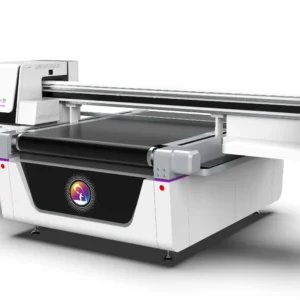
With the advancement of digital manufacturing, UV flatbed printers enable direct printing combined with UV curing technology, allowing rapid transformation from design to finished product. This significantly reduces intermediate processes and improves efficiency and flexibility in cosmetic packaging production.Comparison between UV flatbed printing and traditional printing is as follows:
| Dimension | Traditional Printing | UV Flatbed Printing |
| Plate-making | Required | Not required |
| Sampling speed | Slow | Fast |
| Batch consistency | Average | High stability |
| Material compatibility | Limited | Wide compatibility |
| Small-batch cost | High | Low |
| Design modification | Costly | Instant update |
| Automation level | Low | High |
Overall, UV printing shifts production from a “plate-driven model” to a “data-driven model,” making manufacturing more flexible and efficient.
High-efficiency flexible production capability
UV flatbed printers allow direct printing from digital files without complex plate-making processes, greatly shortening production cycles.
Key advantages include:
- Fast prototyping and mass production switching
- Multi-SKU simultaneous production capability
- Reduced manual intervention through automation
- Ideal for fast product launch cycles in e-commerce
This flexibility enables cosmetic brands to respond quickly to market trends and significantly improve product iteration speed.
High-precision color and visual reproduction
Cosmetic packaging requires extremely high visual quality, especially for logos and gradient effects. UV printing delivers excellent precision and stability.
Key features include:
- Digital color management ensures consistent output
- High-resolution printing reproduces fine details
- Stable color across multiple production batches
- Supports premium texture and visual effects
This ensures consistent brand identity across all product batches, strengthening overall brand perception.
Multi-material and curved surface adaptability
UV flatbed printing supports a wide range of cosmetic packaging materials and expands design possibilities.
Key features include:
- Compatible with glass bottles, acrylic containers, and plastics
- Enables embossed and textured visual effects
- Supports curved and irregular surfaces
- No complex pre-treatment required
This flexibility allows brands to explore more innovative packaging designs and differentiate their products in the market.
Application Scenarios in Cosmetic Packaging
With the growing demand for personalization and premium packaging, UV printing is widely applied across multiple cosmetic segments and has become a key technology for packaging upgrades.
High-end skincare packaging
Used for serums, creams, and perfumes, where brand identity and luxury presentation are critical.
Multi-SKU makeup product packaging
Suitable for lipsticks, eyeshadows, and foundations, enabling fast switching between product designs.
E-commerce rapid launch packaging
Ideal for livestream and online retail products, supporting fast sampling and small-batch production for quick market response.
In the ongoing trend toward personalization and premiumization in the cosmetics industry, UV flatbed printing is gradually replacing traditional printing methods and becoming a core technology for packaging production. It not only improves manufacturing efficiency but also enhances brand consistency and design flexibility. SpringYprinter provides stable and high-performance UV flatbed printing solutions for the cosmetics industry.