In the increasingly competitive cosmetics industry, the speed of new product launches has become a critical factor for brands to gain market advantage. Packaging, as the first point of consumer interaction, not only shapes visual impression but also directly influences brand positioning and perceived value. Therefore, every stage from packaging design to final production must be efficient, precise, and quickly verifiable. Traditional proofing methods are slow and inflexible, making them difficult to meet today’s fast-paced development needs. Against this backdrop, a rapid UV proofing solution based on UV flatbed printers is becoming an essential technical support in cosmetic packaging development.
Practical Challenges in Rapid Cosmetic Packaging Proofing
In the cosmetics industry, new packaging development often involves frequent design changes, multi-material testing, and strict brand visual consistency requirements. Any inefficiency in one stage can impact the overall product launch schedule.
Tight product development cycles and compressed proofing time
The cosmetics industry often has very short product launch windows, especially for seasonal or limited-edition products.
Common issues include:
- Designs require multiple rapid confirmation rounds, but proofing cycles are long
- Marketing teams need fast feedback, but physical samples cannot keep up
- Brand decisions are made under tight deadlines, increasing pressure on proofing
- Multiple product lines developed simultaneously cause scheduling conflicts
This time pressure can significantly delay product launches and cause brands to miss optimal market opportunities.
Complex packaging materials increase proofing difficulty
Cosmetic packaging typically involves multiple material combinations, each with different processing requirements.
Key characteristics include:
- Glass bottles, plastic containers, and metal caps used together
- Different materials have varying ink absorption and adhesion properties
- Traditional methods require separate processes for different materials
- Difficult to maintain consistent visual appearance across samples
This complexity turns proofing into a multi-variable coordination process rather than simple printing.
Gaps between design and physical samples affect decision efficiency
In cosmetics, visual appearance determines product perception, but digital designs often differ from real samples.
Common issues include:
- Color inconsistency across different materials
- Insufficient detail reproduction in physical samples
- Inability to fully replicate gloss and texture
- Extended client approval cycles
These gaps increase iteration cycles and reduce overall development efficiency.
Core Advantages of UV Flatbed Printers in Cosmetic Rapid Proofing
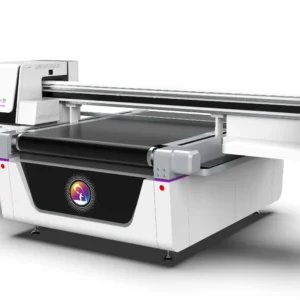
Under the trend of digital transformation in the cosmetics industry, UV flatbed printers use direct inkjet printing and UV curing technology to quickly convert designs into physical samples, making the proofing process more efficient and controllable.
Before exploring detailed advantages, it is important to understand the overall efficiency differences
In real product development, brands usually choose between traditional proofing methods and UV flatbed printing solutions. The differences are not only in speed but also in workflow logic, modification cost, and multi-version management capability:
| Comparison | Traditional Proofing | UV Flatbed Printing |
| Proofing cycle | Days to weeks | Hours to 1 day |
| Plate making required | Yes | No |
| Modification method | Reproduction required | Direct file update |
| Multi-version support | Weak | Strong |
| Material compatibility | Limited | Glass/plastic/metal compatible |
| Color consistency | Unstable | Digitally controlled |
| Suitable stage | Mass production | Early-stage development |
From this perspective, traditional methods are more production-oriented, while UV solutions are better suited for rapid iteration and validation during new product development.
Direct multi-material output improves flexibility
UV technology can directly print on various cosmetic packaging materials without complex pre-processing.
Advantages include:
- Direct printing on glass, plastic, acrylic, and metal
- Reduced plate-making and transfer processes
- Shorter preparation time
- Suitable for diverse cosmetic packaging types
High-precision color reproduction ensures brand consistency
Brand color is a core asset in cosmetics, and any deviation affects consumer perception.
Key features include:
- Digital color management ensures standard output
- Minimal color deviation between batches
- Stable reproduction of gradients and details
- Consistent appearance across different materials
Texture and craft simulation improves sample realism
UV proofing not only prints images but also simulates high-end packaging effects.
Capabilities include:
- White ink enhances layering
- Varnish creates localized gloss effects
- Embossing and foil-like visual simulation
- Enhanced premium product appearance
Fast multi-version output supports testing needs
Cosmetic products often require multiple design versions for comparison.
Advantages include:
- No plate-making required for switching designs
- Supports parallel version output
- Suitable for A/B testing
- Reduces cost and time of trial-and-error
Standard UV Proofing Workflow and Key Control Points
In cosmetic packaging development, rapid proofing relies not only on equipment but also on standardized workflows to ensure consistency and repeatability.
Standardized design file preparation
Before proofing, design files must be standardized to avoid output deviation.
Includes:
- Unified resolution and sizing
- Standard color mode and bleed settings
- Complete layer structure checks
- Material compatibility considerations
- Consistent visual system across product lines
This stage establishes a standardized communication interface between design and production. Without it, even advanced UV systems cannot ensure output consistency.
UV printer color calibration and parameter control
UV flatbed printers must be properly calibrated to ensure stable output.
Key elements include:
- ICC color management system
- Printhead and ink system calibration
- Material-specific parameter settings
- Batch consistency control
- Long-term stability monitoring
This directly determines whether samples are reliable for brand decision-making.
Material testing and adhesion verification
Different packaging materials must be tested to avoid production risks.
Key tests include:
- Ink adhesion and scratch resistance
- Material absorption evaluation
- Surface gloss consistency checks
- Long-term durability simulation
- Transport friction testing
Multi-round rapid iteration optimization
The core of rapid proofing is continuous optimization rather than one-time completion.
Features include:
- Multiple fast revision cycles
- Real-time design adjustments based on feedback
- Shortened approval cycles
- Improved final success rate
- Reduced communication and rework costs
This transforms cosmetic packaging development from experience-driven to data- and sample-driven decision-making.
In the context of the cosmetics industry’s pursuit of both speed and quality, rapid UV proofing has become a fundamental capability in packaging development. The UV flatbed printing solution continues to improve the efficiency of the entire workflow, and SpringYprinter provides stable and efficient UV proofing support for cosmetic companies.