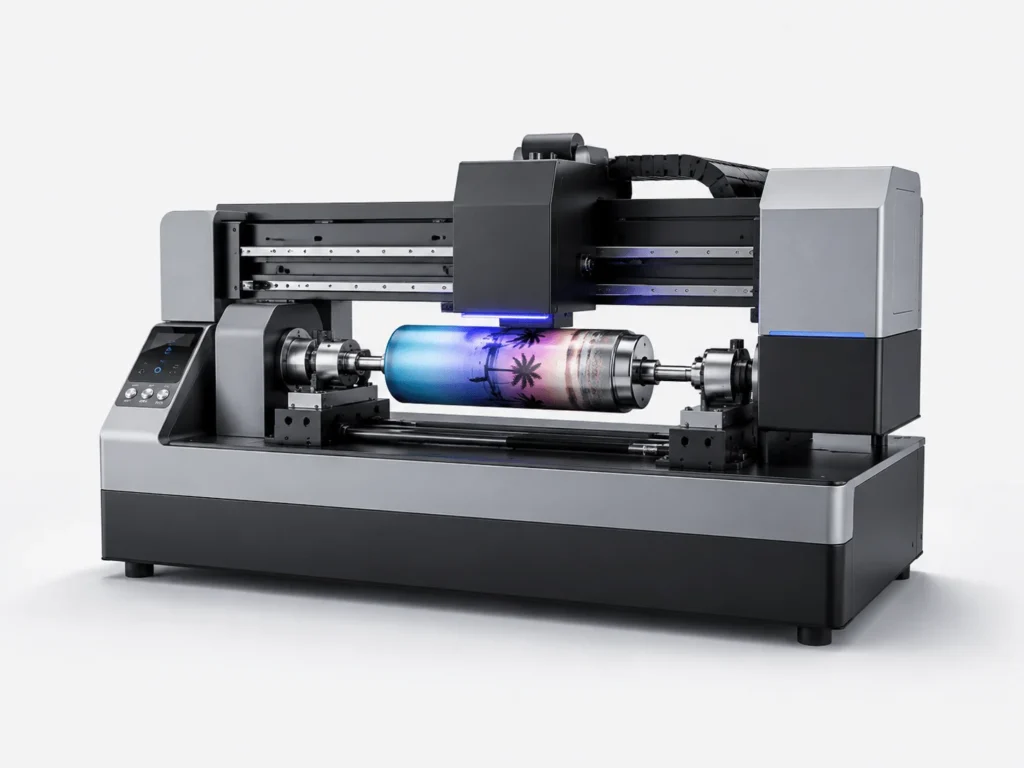
The cosmetics industry has increasingly higher requirements for packaging. Appearance design not only needs to reflect brand identity, but also must ensure product recognizability and market competitiveness. Cylindrical bottles are widely used in skincare, perfumes, serums, and personal care products. Traditional labeling or screen printing methods often lack flexibility when facing multi-style, small-batch, and fast-iteration demands. Cylindrical printers use digital technology to directly print patterns on curved surfaces, enabling more creative packaging designs and providing a new production approach for the cosmetics industry.
Cylindrical Printer Compatibility with Cosmetic Packaging Structures
Cylindrical packaging is widely used in the cosmetics industry, and structural compatibility directly affects its practical application value.
Supports Various Cylindrical Container Forms
Cosmetic packaging comes in many forms, with cylindrical structures being among the most common. Different product categories also have different appearance requirements.
- Skincare bottles can directly display brand graphics, enabling unified visuals and quick series switching.
- Perfume and essential oil bottles are suitable for high-precision printing, making details and branding clearer.
- Personal care products can maintain a consistent visual style, improving shelf recognition.
- Cosmetic tool storage tubes can be customized for both decoration and brand communication.
This compatibility allows packaging designs to be fully presented directly on the container surface.
Enhances Overall Visual Impact of Packaging
Cosmetic packaging is a key medium for the first impression between brands and consumers, making visual performance especially important. High-definition printing can reproduce illustrations, textures, and gradients. Logos and brand elements remain clear under different lighting conditions. Gradient and illustration effects are easier to achieve, making packaging styles more diverse and artistically expressive. Different product series can quickly switch designs, enhancing shelf appeal and strengthening brand recognition.
Cylindrical Printer Meets Customization Needs in Cosmetics
As market personalization trends grow, cosmetic packaging is gradually shifting from standardization to diversified customized production.
Adapts to Small-Batch Multi-Category Production
The cosmetics market evolves rapidly, with frequent product line updates requiring high production flexibility.
- New product trials can be quickly sampled and validated, shortening time-to-market.
- Small-batch orders can be produced flexibly for market testing.
- Multiple packaging styles can be produced on the same machine.
- Limited editions and co-branded products are easier to achieve, supporting marketing campaigns and seasonal demand.
This flexibility helps brands respond quickly to market changes and reduce development risks.
Supports Personalized Packaging Marketing Strategies
Personalized packaging has become an important way for brands to enhance competitiveness.
- Holiday limited editions increase purchase appeal.
- Brand campaigns can use exclusive visuals to improve memorability.
- Different channels can adopt differentiated designs for targeted visual strategies.
- Gift packaging gains higher collectible and emotional value.
Packaging thus evolves from a container into a brand marketing carrier.
Print Quality Affects Cosmetic Packaging Grade
Packaging detail quality directly influences consumers’ perception of product value.
High-Precision Output Ensures Detail Presentation
Cosmetic packaging contains complex information and requires high printing accuracy.
- Small text must remain legible without blurring or breaking on curved surfaces.
- Logos must be accurately reproduced to ensure brand consistency.
- Graphic edges should be smooth without jagged lines or ink bleeding.
- Large color blocks must remain uniform and consistent across batches.
High-precision output directly impacts product texture and brand visual competitiveness.
Material Compatibility Affects Final Results
Different materials significantly affect printing performance and require matching process solutions. Glass bottles require strong adhesion and stability. Plastic bottles need surface treatment optimization to improve adhesion. Metal packaging requires higher scratch resistance and bonding strength. Material compatibility determines printing stability and long-term performance.
Cylindrical Printer Improves Production Efficiency
With faster order cycles, production efficiency has become a key competitive factor for enterprises.
Digital Workflow Shortens Production Cycle
Digital printing simplifies traditional production processes.
- Design files can be directly imported into the machine.
- No complex plate-making or proofing is required.
- Design modifications can be output immediately.
- Multiple orders can be produced continuously, improving equipment utilization.
Production cycles are significantly shortened.
Automation Reduces Labor Costs
Equipment operation becomes more intelligent and standardized.
- Automatic positioning reduces manual adjustment.
- Batch tasks can run continuously.
- Standardized workflows reduce labor dependency.
- Human errors and rework costs are minimized.
Automation improves production stability and scalability.
Cylindrical printers demonstrate strong compatibility in cosmetic packaging applications, offering improvements in structural adaptability, customization capability, and production efficiency. Springyprinter focuses on industrial digital printing equipment development, providing stable and efficient digital solutions for the packaging industry. It is especially suitable for small-batch and multi-style packaging production scenarios, effectively shortening proofing and delivery cycles while helping brands enhance product visual differentiation in a highly competitive market.