In today’s highly competitive manufacturing and customization market, companies increasingly rely on efficient and flexible production methods to meet rapidly changing order demands. Especially in e-commerce, brand customization, and industrial labeling, product designs are frequently updated and batch structures are highly complex. Traditional single processes can no longer fully support fast delivery requirements. UV printing and screen printing are two of the most commonly used printing technologies today. One represents digital and flexible production, while the other represents a mature and stable mass-production method. Their differences in efficiency, cost, and output quality directly affect production strategies and profit margins. Understanding these differences helps businesses make better decisions in batch production.
Basic Principles of UV Printing and Screen Printing
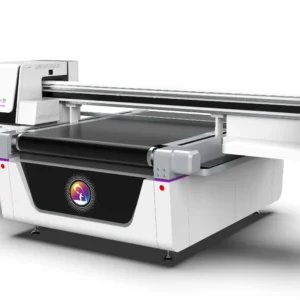
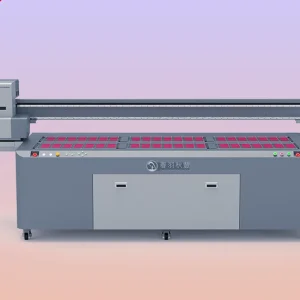
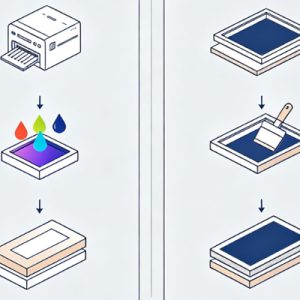
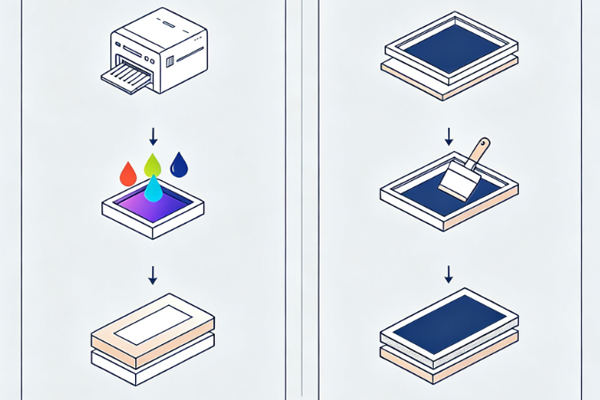
UV printing is a digital inkjet technology that directly sprays UV ink onto the material surface and cures it instantly with ultraviolet light. It does not require plate-making and can produce complex designs quickly. Screen printing transfers ink through a mesh screen, requiring stencil preparation in advance, which involves plate-making and setup time.
Key differences in production logic:
- UV printing is data-driven with fast design switching
- Screen printing relies on stencil production and fixed processes
- UV printing is suitable for diversified and flexible orders
- Screen printing is better for long-term stable repeat orders
Efficiency Comparison in Mass Production
In batch production, efficiency directly affects delivery capability. UV printing does not require plate-making, allowing production to start immediately after order confirmation, significantly reducing waiting time. It performs especially well in multi-SKU and frequently changing design orders.
Key advantages include:
- No plate-making process, faster startup time
- Easy design switching, adaptable to multiple order types
- High automation level for continuous production
- Ideal for e-commerce customization and short-cycle orders
Screen printing is stable in large-volume single-design production, but every design change requires new plates and adjustments, making the production rhythm less flexible.
Cost Structure Comparison
UV printing cost features:
- No plate-making cost, lower initial investment
- Higher ink cost per unit
- Suitable for small batches and multi-category orders
- Lower labor dependency
Screen printing cost features:
- Fixed plate cost, more economical for large orders
- Lower unit cost in high-volume production
- More labor involvement required
- Higher cost pressure for small batches
Print Quality and Application Scenarios
UV printing enables high-resolution output, including gradients and photo-quality images. It is suitable for various materials such as metal, plastic, and glass, making it ideal for branded customization products.
Screen printing offers strong color saturation and excellent opacity with high durability. It is commonly used in industrial labeling, packaging printing, and standardized mass production.
Typical applications:
- UV printing: customized gifts, e-commerce products, personalized consumer goods
- Screen printing: industrial manufacturing, packaging, large-scale standardized products
Choosing the Right Method for Mass Production
When selecting a printing process, businesses should evaluate their order structure and operational needs.
Consider the following guidelines:
- Frequent design changes and multiple SKUs: UV printing is more suitable
- Stable orders with fixed designs: screen printing is more cost-effective
- High visual quality requirements: UV printing is preferable
- Extremely low unit cost priority: screen printing is better
Some companies adopt a hybrid approach using both technologies to better match different production needs.
In today’s printing industry, which is rapidly moving toward digitalization and flexibility, UV printing is transforming traditional production models with its plate-free workflow, fast response, and multi-material compatibility. It is especially advantageous in customized and small-batch production. Screen printing still maintains strong cost efficiency in large-scale stable production. Businesses should choose based on their order structure and long-term development strategy. UV printing is becoming an increasingly important solution for improving production efficiency. SpringYprinter provides efficient and stable UV printing solutions for modern businesses.