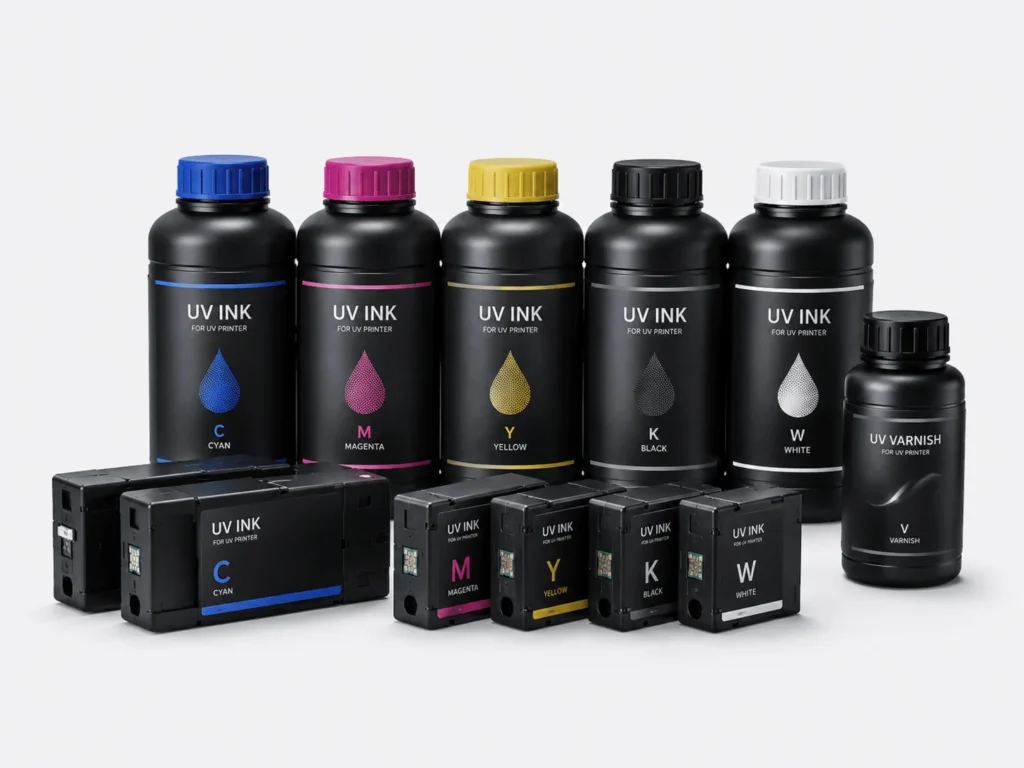
UV LED ink is widely used in UV flatbed printers, UV roll-to-roll printers, and industrial inkjet equipment. It is extensively applied in industries such as advertising production, packaging printing, promotional gifts, and decorative building materials. During daily production, many businesses consider mixing different brands of UV LED ink in order to reduce purchasing costs or temporarily replenish inventory. However, although different brands are all classified as UV LED ink, they differ in formulation, raw materials, photoinitiators, pigment ratios, viscosity, and other characteristics. Mixing them arbitrarily may not only affect print quality but also impact the printhead, ink supply system, and final product quality. Therefore, before deciding whether to mix different brands of ink, it is important to fully understand the potential risks and precautions to avoid increasing production costs due to improper operation.
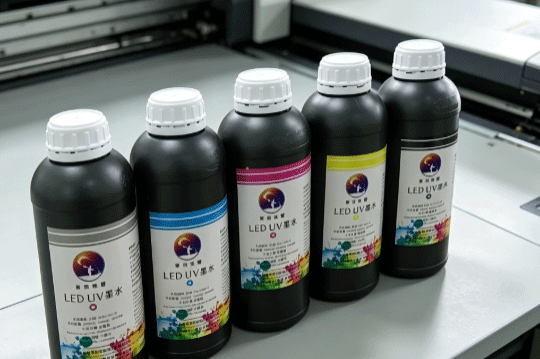
Why Is It Not Recommended to Mix Different Brands of UV LED Ink?
Ink Formulations Are Different
Although UV LED inks on the market all use ultraviolet curing technology, every manufacturer develops its own proprietary formulation, so ink performance is not exactly the same.Different brands vary in resin types, pigment concentrations, photoinitiator ratios, and additive formulations. Some inks have better flowability, while others focus more on adhesion or abrasion resistance. When two inks with different formulations are mixed, incompatibility may occur, affecting overall stability and resulting in color variation, improper curing, or poor leveling during printing.
It Can Easily Affect Printhead Performance
The printhead is one of the most important components of UV printing equipment and requires highly stable ink performance. Therefore, the ink system should not be changed arbitrarily.If different brands of ink are mixed and slight coagulation, sedimentation, or viscosity changes occur, they may clog the printhead nozzles, interrupt ink flow, or cause ink misting. Minor issues may affect print quality, while more serious problems may increase the frequency of printhead cleaning or even shorten the service life of the printhead. For expensive industrial printheads, the resulting maintenance costs are often much higher than the savings achieved by mixing inks.
Print Quality May Become Inconsistent
Mixing different brands of ink may result in color deviations, inconsistent gloss, reduced adhesion, and changes in abrasion resistance.If products within the same production batch have inconsistent colors, customer acceptance may also be affected. Therefore, to ensure consistent product quality, manufacturers generally use the same brand and the same ink series throughout the production process.
Under What Circumstances Should Different Inks Absolutely Not Be Mixed?
Adding a New Brand of Ink Directly into the Existing Ink Cartridge
Many users attempt to save leftover ink by directly adding a new brand of ink into the existing cartridge. This practice is not recommended.
- Even if the two inks have the same color, different brands may contain different internal formulations, and mixing them can affect printing stability.
- If the ink supply system has not been cleaned beforehand, the old and new inks will mix inside the ink tubes and cartridges, potentially affecting curing performance and inkjet operation.
- When changing brands, it is recommended to completely clean the ink supply system before filling it with the new ink. This is safer and more beneficial for subsequent printing.
Mixing Different Color Series
Some users believe that only white ink requires special attention, but color inks should not be mixed either.The cyan, magenta, yellow, and black inks produced by different manufacturers do not have identical pigment formulations. Mixing them may cause printed colors to differ from the existing color management profiles, resulting in color deviations and increasing the amount of color correction and rework required.
Mixing Inks Designed for Different Applications
There are currently several types of UV LED inks available on the market, including rigid inks, flexible inks, and soft inks.These inks are specifically designed for different materials such as glass, acrylic, metal, flexible PVC films, and leather. Mixing inks intended for different applications may reduce adhesion while also affecting flexibility, scratch resistance, and product durability. Therefore, the appropriate ink type should always be selected according to the printing material.
What Should You Do If You Must Change Ink Brands?
Thoroughly Clean the Ink Supply System
When changing ink brands, businesses should not rush to fill the printer with new ink. Proper cleaning should be performed first.Follow the equipment manufacturer’s maintenance procedures and use a dedicated cleaning solution to clean the ink cartridges, ink tubes, filters, and printheads, removing as much of the original ink as possible. This minimizes the possibility of chemical reactions between different inks and helps ensure more stable printing afterward.
Perform Small-Batch Testing First
Before beginning full-scale production, it is recommended to perform testing rather than immediately starting mass production.Print color blocks, text, and commonly used graphics first to evaluate color performance, adhesion, curing quality, and printhead operation. If the test results are satisfactory and stable, formal production can begin, effectively reducing the risk of large-scale rework.
Readjust the Printing Parameters
Different ink brands may require different printer settings, so equipment parameters should be recalibrated after changing inks.Parameters including inkjet voltage, printing speed, UV curing lamp power, and color profiles should all be readjusted. Proper parameter optimization allows the new ink to deliver better printing performance while maintaining stable product quality.
Frequently Asked Questions
Can the Same Type of Ink Be Mixed Directly?
Even if both products are UV LED inks, direct mixing is still not recommended.Although they appear to belong to the same category, different brands use different raw materials and manufacturing processes. Mixing them may affect overall stability, so it is best to continue using a single brand.
Can White Inks from Different Brands Be Mixed?
White ink requires even greater caution than color ink.Since white ink contains a larger amount of pigment particles, different brands are more likely to develop sedimentation or uneven pigment dispersion after mixing. Therefore, the risk is higher, and mixing is generally not recommended.
Is It Acceptable to Mix a Small Amount in an Emergency?
Some companies consider mixing a small amount of ink when facing urgent production orders.Even a small quantity may affect the entire ink supply system, so mixing should still be avoided whenever possible. If it is absolutely unavoidable, thorough testing should be performed first, and the equipment should be cleaned immediately after completing the order.
Although all UV LED inks belong to the category of UV-curable inks, different brands differ in formulation, performance, and compatibility requirements. Therefore, directly mixing different brands is generally not recommended. Arbitrary mixing may not only affect color performance, adhesion, and curing quality but also lead to printhead clogging, contamination of the ink supply system, and increased equipment maintenance costs.
Consistently using the same brand and the same series of ink is one of the most effective ways to maintain stable printing quality. If changing brands becomes necessary due to production requirements, the ink supply system should be cleaned thoroughly beforehand, small-batch testing should be completed, and the printing parameters should be recalibrated. Only after confirming full compatibility between the equipment and the new ink should formal production begin. This approach effectively reduces production risks while ensuring stable equipment operation and consistent product quality.