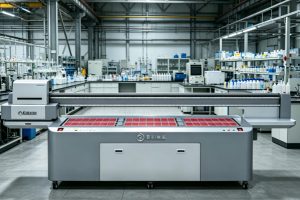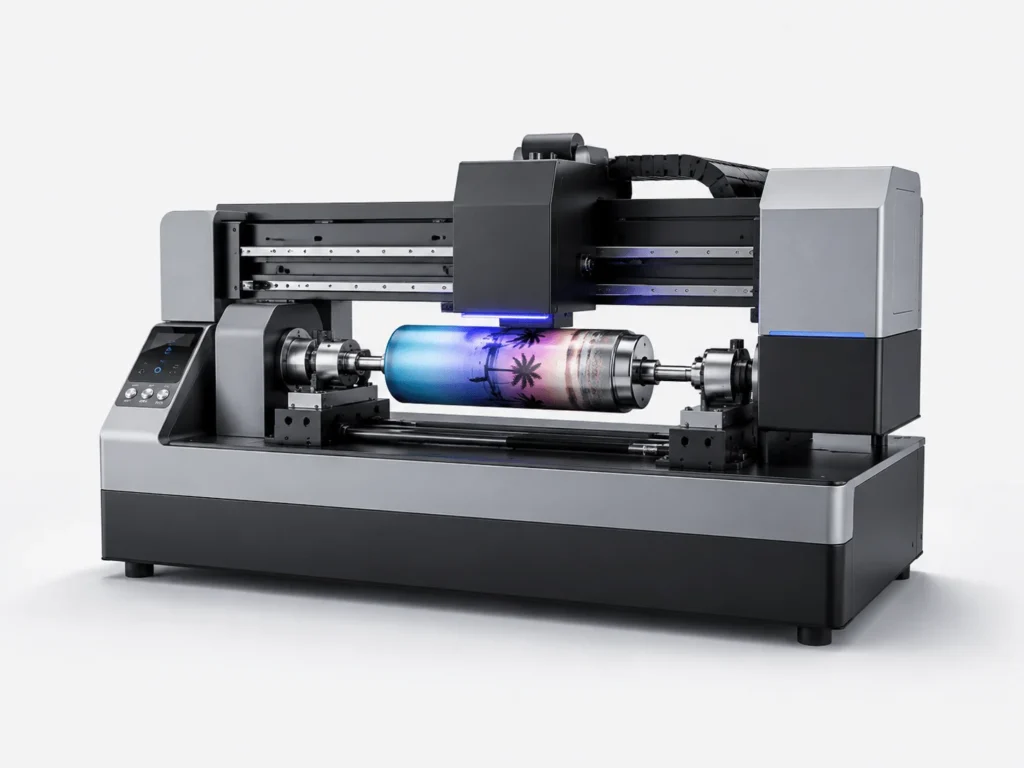
As packaging printing, advertising production, appliance panels, and industrial customization continue to upgrade, UV flatbed conveyor printers are no longer just machines that “can print.” They have become important production tools that directly affect delivery speed, product quality, and business profit. Faced with different brands, different printhead configurations, and different automation solutions on the market, many buyers hesitate: how can they choose a model that truly fits their needs? In fact, selecting equipment is not just about price or specifications. It requires a comprehensive judgment based on product type, order structure, production capacity goals, and after-sales service. Choosing the right machine means turning investment into efficiency and return faster.
Clarify Your Own Production Needs
Before selecting equipment, it is more important to sort out your business scenario than to blindly compare specifications. Only when you know what products you want to make and what kinds of orders you will take can your choice stay on the right track.
First Look at Your Main Processing Products
Different products have very different requirements for equipment, so they cannot be selected using the same standard.
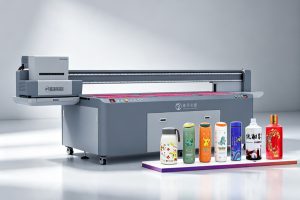
- Packaging color printing places more emphasis on continuous output and batch efficiency, because these products usually involve large order volumes and tight delivery schedules. The machine must be able to run stably for long periods and reduce losses caused by frequent downtime.
- Appliance panels and electronic housings place more emphasis on precision and color reproduction. These products often require high standards for image edges, text clarity, and brand recognition. Even slight deviations can affect the final product grade.
- Advertising display products focus more on print width and delivery speed. Especially for display boards, signage, and promotional materials, fast sampling and fast delivery are often required, so the machine’s response efficiency is crucial.
- Industrial custom products place more emphasis on stability and durability, because these products often involve different materials, thicknesses, and process requirements. The stronger the machine’s adaptability, the smoother the production.
The clearer the product type, the more accurate the equipment selection, and the easier it is to avoid buying a machine that “works but does not work well.”
Then Look at Order Structure and Production Rhythm
The order model directly affects the direction of equipment configuration, especially production rhythm and switching efficiency.
- Large-volume orders are suitable for equipment with higher levels of continuous and automated production, because these orders emphasize output per unit time. If the machine loads and unloads slowly or requires too much manual intervention, the overall delivery schedule will be delayed.
- Small-batch customization requires flexible switching and fast proofing. Many customers may need one sample today and a different design tomorrow. If the switching process is too complicated, communication and waiting costs will increase.
- Multi-style and multi-version orders require faster machine response. This is especially true in industries such as e-commerce packaging, holiday gift boxes, and personalized gifts, where orders change frequently and the machine must be highly adaptable.
If a company often works under tight deadlines, the machine’s stable output capability is often more important than speed alone. What really affects production efficiency is not only “running fast,” but also “whether it can keep running and whether it runs steadily.”
Pay Attention to Core Configuration Parameters
Whether a machine is easy to use is best reflected by its core configuration. Many companies only look at appearance and price, only to later discover that the parts that truly affect production are the printheads, conveyor system, and curing system.
Whether the Printhead Configuration Matches Your Needs
The printhead is the core component of a UV printer and directly determines print quality and operating efficiency.
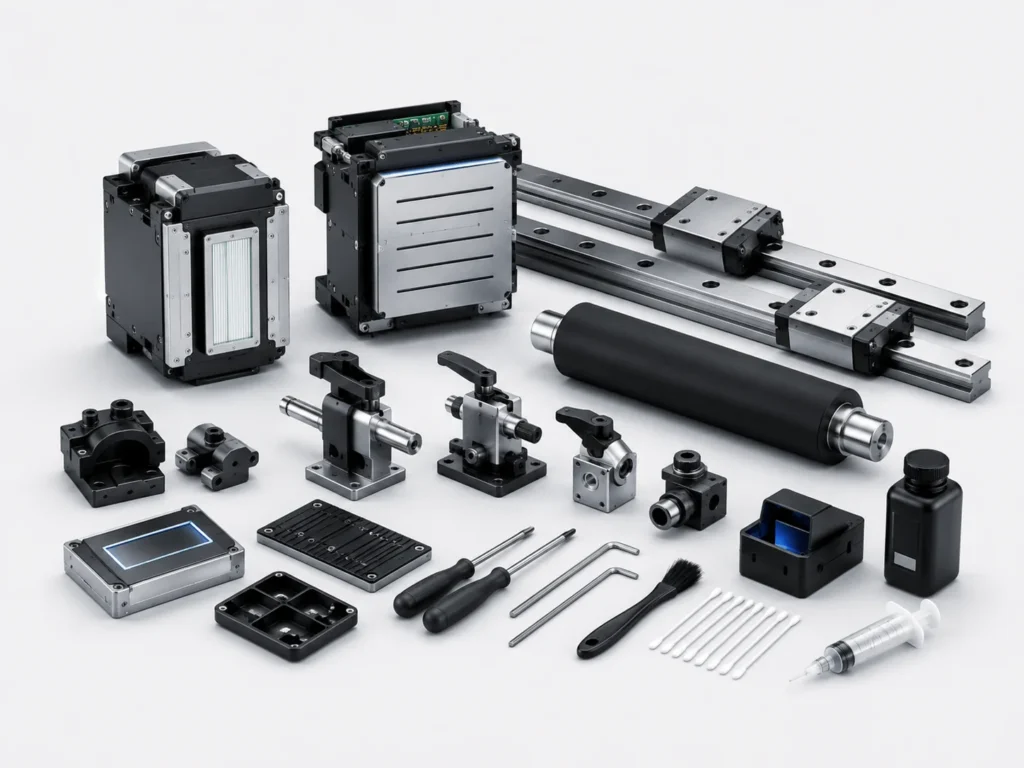
- The number of printheads affects printing speed and output capacity. More printheads mean higher theoretical output, but they also place higher demands on the control system, ink system, and maintenance capability.
- The printhead model affects precision, grayscale performance, and detail rendering. Different printheads vary significantly in nozzle design, droplet control, and stability, and they are suitable for different application scenarios.
- Printhead stability affects long-term operational reliability. If the printhead is prone to clogging, misfiring, or short lifespan, it will not only increase maintenance costs but also affect order delivery.
Choosing printheads is not about the more the better. It should match product positioning, order volume, and budget. For companies pursuing high precision, a solution with fine imaging and strong stability should be prioritized. For companies pursuing output capacity, speed and continuous operation capability must also be considered.
Whether the Conveyor and Curing Systems Are Stable
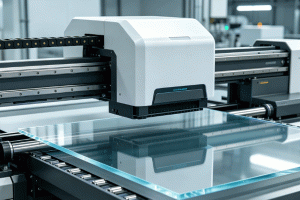
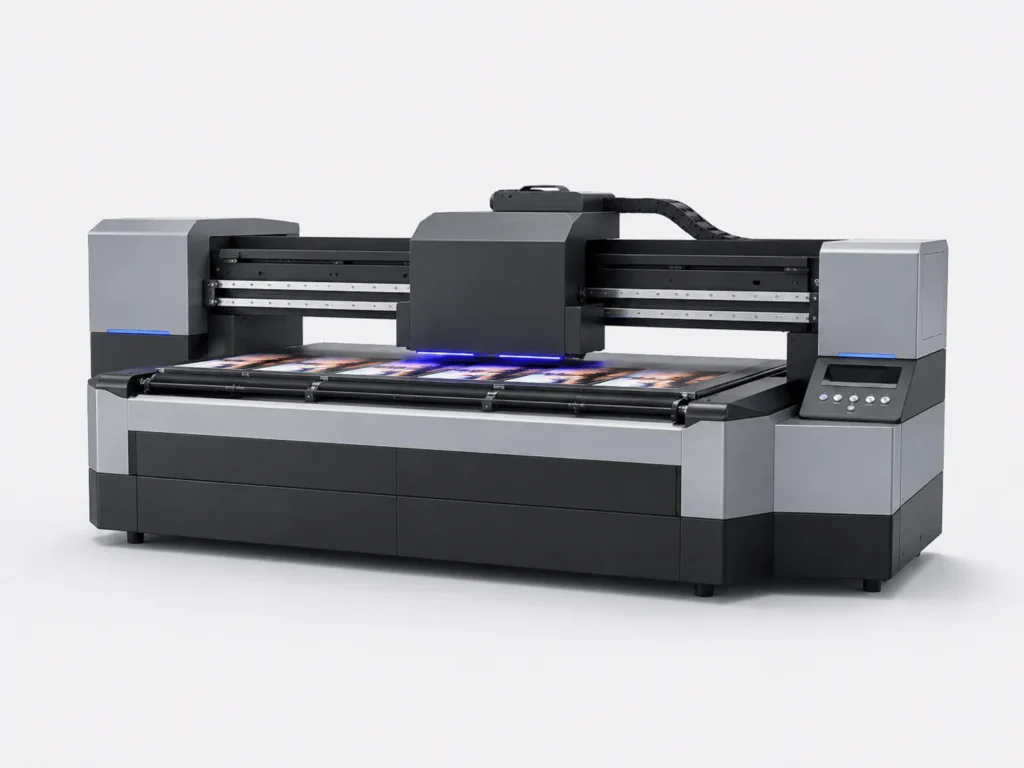
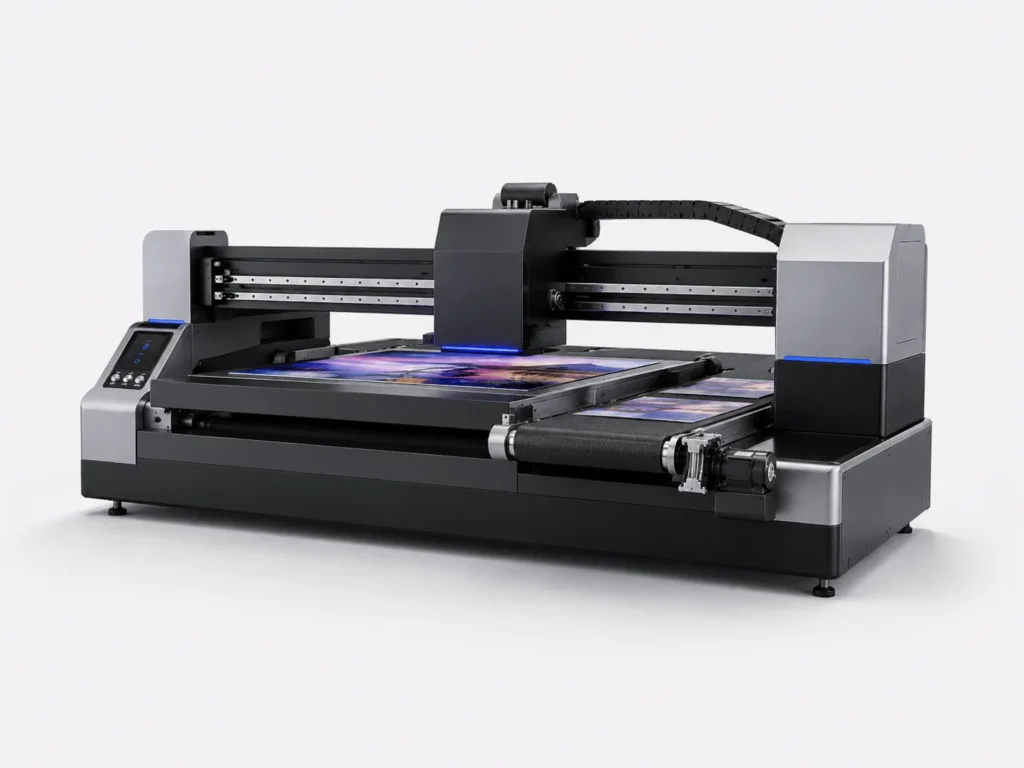
The advantage of a conveyor-type machine lies in continuous feeding, so the conveyor system and UV curing system must be reliable enough.
- Whether the conveyor belt runs smoothly determines whether material positioning is accurate. If there is deviation, shaking, or slipping during transport, the image position will easily shift, and in severe cases the entire batch may need to be reworked.
- Whether the curing speed is even affects ink adhesion and wear resistance. Insufficient curing can cause the surface to feel sticky, fade, or lack durability, and problems are especially likely to appear in industrial and packaging applications.
- Whether the machine remains stable during long-term operation affects batch production efficiency. If the machine has poor temperature control or slow system response during continuous work, the rhythm of the entire production line will be affected.
If these two parts are unstable, even the best printhead cannot deliver its true value. For companies that are truly putting the machine into production, the conveyor and curing systems are often more important than appearance-related specifications.
Evaluate the Machine’s Production Capacity
For companies that are truly planning to put the machine into production, whether it can keep running is more important than promotional specifications. Production capacity is reflected not only in speed, but also in automation and stability.
Check the Actual Printing Efficiency
Machine specifications and actual production are often not the same thing, especially under different materials and different precision modes, where efficiency can vary greatly.
- Pay attention to the real speed in high-precision mode, because many machines advertise speed under ideal conditions, while actual production usually slows down to ensure image quality.
- Understand the stability of continuous printing output, especially whether color deviation, ink interruption, or misalignment occurs after long periods of operation, as these issues directly affect order quality.
- Whenever possible, judge actual output through on-site testing. It is best to test using the company’s commonly used materials and typical designs so that the data is closer to real production conditions.
Only real production data can truly reflect whether the machine is suitable for the company. Rather than looking at numbers on a brochure, it is better to see whether the machine can complete tasks stably under actual working conditions.
Check Automation Level and Continuous Running Capability
The higher the automation level, the more suitable the machine is for batch production and the more it can reduce labor costs.
- Automatic feeding reduces handling time and makes material entry into the printing area smoother, especially for standardized boards and continuous orders.
- Automatic positioning helps improve printing accuracy, reduces manual placement errors, and keeps products from different batches more consistent.
- Automatic unloading makes the production process smoother, reduces waiting and repetitive operations, and brings the machine closer to a true assembly-line workflow.
At the same time, whether the machine is prone to shutdowns or misalignment also determines whether it can serve orders stably over the long term. For manufacturing companies, once the machine enters high-frequency use, stability is often more important than single-run speed, because one shutdown may cause losses far greater than the gains from a slight speed increase.
Compare the Overall Value of Different Machines
When purchasing equipment, you should not only look at the one-time price, but also at how much return it can bring over its entire service life. A truly worthwhile machine is often the one with lower overall cost and easier operation.
Compare from Multiple Dimensions
When selecting a model, you can place key indicators side by side to better judge the machine’s value.
- Printhead configuration should be evaluated in terms of precision, speed, and lifespan. It should meet current order needs while also considering whether future maintenance will be convenient.
- Printing width should match product specifications. If the width is too small, it limits product types; if it is too large, it may reduce equipment utilization.
- The conveyor system should be judged by stability and continuous production capability. Especially in batch-order scenarios, whether the conveyor runs smoothly directly affects overall machine efficiency.
- The UV curing system should be evaluated by curing performance and energy consumption. Machines with high curing efficiency and reasonable energy use have more advantages in long-term operation.
Only by combining these factors can you avoid being misled by a single specification. In many cases, the machine that truly suits a company is not necessarily the one with the most impressive parameters, but the one with the most balanced overall performance.
Focus on Long-Term Operating Costs and Manufacturer Strength
Buying the machine is only the beginning. Ongoing costs and service are what truly affect profit.
- Whether ink consumption and maintenance costs are controllable determines the machine’s long-term economy, especially for companies with high-frequency production that need to pay close attention to consumable costs.
- Whether replacement parts are easy to obtain affects how quickly production can resume after a problem occurs, preventing delays caused by waiting for parts.
- Whether the manufacturer has R&D capability and mature cases shows whether the equipment has been validated by the market and also reflects its ability to upgrade and improve later.
- Whether after-sales response is timely and training is complete directly affects deployment speed and operational stability.
A strong manufacturer does not just sell equipment; it helps the company truly put the equipment into use. For buyers, choosing a reliable partner is often more important than simply buying a machine.
After-Sales Service Should Not Be Ignored
Many companies tend to overlook after-sales service during procurement, but once the machine enters production, service capability often becomes more important than the sales stage because it directly affects downtime and production continuity.
Is Technical Support Timely?
During production, issues such as parameter adjustment, software settings, or equipment abnormalities are inevitable, and the manufacturer’s response speed becomes crucial at such times.
- Whether remote guidance is available can help the company troubleshoot problems immediately and reduce waiting time.
- Whether faults can be handled quickly, especially core issues that affect production, determines how small the losses will be.
- Whether the manufacturer can help optimize production parameters is also important, because different materials, designs, and environments may require adjustments. Professional support helps the machine perform better.
Timely technical support helps companies reduce losses and allows the machine to return to production faster. This is especially important for order-intensive businesses.
Are Spare Parts Supply and Training Systems Complete?
Long-term machine use depends on spare parts and training support, and these two factors often determine whether the machine remains worry-free.
- Whether common spare parts are supplied stably determines whether maintenance is smooth and prevents small parts shortages from affecting the whole machine.
- Whether the repair cycle is clear helps companies arrange production plans in advance and reduce disruption caused by unexpected downtime.
- Whether operation training and daily maintenance guidance are provided affects how quickly employees can get started and also influences the machine’s lifespan and stability.
A complete service system helps the machine build stable production capacity faster and reduces human operating errors. For companies seeking long-term development, after-sales service is not an extra feature but an important part of the machine’s value.
In actual procurement, companies should start from their application scenarios, focus on whether the machine can stably adapt to existing processes, whether it is convenient for future expansion, and whether it has sustainable maintenance support. Only by considering all these factors can the machine truly serve production instead of becoming an operational burden later. Springyprinter specializes in industrial UV digital printing equipment R&D and manufacturing, and can provide customers with professional UV flatbed conveyor printing solutions and comprehensive technical support services.