In today’s rapidly evolving advertising industry, multi-material applications have become the mainstream trend. Commercial spaces, brand stores, and exhibition projects increasingly require complex combinations of materials rather than single-substrate outputs. Traditional screen printing and spray printing struggle in such environments, as they require frequent equipment switching and multi-step processing, which leads to lower efficiency and inconsistent results. UV printers, with their direct multi-material printing capability and instant curing technology, are becoming a core solution for handling complex material requirements in modern advertising production.
Industry Pain Points and Structural Bottlenecks in Multi-Material Advertising Production
In real production scenarios, multi-material projects are now the norm, but traditional production systems are still based on single-material workflows. This leads to fragmented production chains, where each material requires different pre-treatment and processing methods, significantly reducing efficiency.
As the advertising industry shifts from single visual output to integrated spatial design solutions, production systems must meet higher demands for multi-material compatibility, fast delivery, and consistent quality. Traditional printing systems are increasingly unable to adapt to this transformation.
Production Complexity Caused by Multi-Material Orders
In real projects, a single advertising solution often includes multiple materials such as lightbox panels, background wall decorations, and signage systems. Each material requires different processing logic.
Key challenges include:
- Different materials require separate printing parameter testing
- Frequent material switching interrupts production flow
- Multiple machines increase operational complexity
- Small-batch, multi-type orders are difficult to schedule uniformly
- High outsourcing dependence reduces delivery control
These factors make it difficult to achieve stable efficiency improvements, even with additional equipment.
Lack of Stability in Traditional Screen Printing for Multi-Material Applications
Traditional screen printing relies heavily on operator experience for material adaptation. While this may work for single-material production, it becomes unstable in multi-material environments.
Common issues include:
- Inconsistent color reproduction across different materials
- Noticeable color deviation between batches
- Unstable ink adhesion on various surfaces
- Fading or peeling during long-term use
- Difficulty maintaining brand consistency
These issues directly affect product quality and customer satisfaction.
Core UV Printer Solutions for Multi-Material Advertising
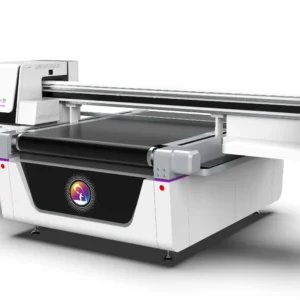
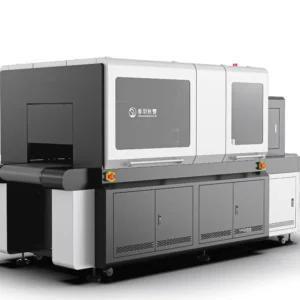
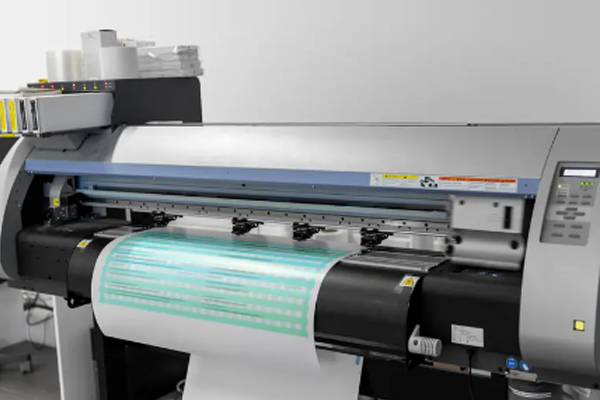
UV printers use UV instant curing technology and a digital output system to achieve unified multi-material production. This transforms advertising production from “material-based workflow separation” to a “unified production platform,” significantly improving both efficiency and stability.
UV printing has already become the mainstream solution in commercial advertising, exhibition production, and brand spatial design.
Multi-Material Compatibility Capability (Application-Level Solution)
One of the biggest advantages of UV printers is their ability to print directly on a wide range of advertising materials without process separation.
Capabilities include:
- Supports acrylic, PVC, wood, glass, and metal
- Suitable for lightboxes, display boards, signage, and wall decoration
- Eliminates lamination and transfer processes
- Supports both flat and structured surfaces
- Handles both small-batch customization and mass production
- Reduces reliance on outsourcing and external processing
This capability significantly expands the business scope of advertising companies.
Core UV Printing Production Capabilities (Technical Level Solution)
Beyond material compatibility, UV printing fundamentally reconstructs the production logic, moving toward a digital manufacturing model.
Core capabilities include:
- UV instant curing enables immediate drying
- Digital color management ensures consistent output
- Integrated workflow reduces intermediate processes
- High-precision print heads enhance image detail
- Supports continuous and mixed-order production
- Reduces labor dependency and improves stability
These features make production more standardized and less dependent on manual operation.
UV Multi-Material Solution Capability Matrix (Technology vs Application)
| Dimension | Application-Level Impact | Technical Support |
| Material compatibility | Flexible multi-scenario design | UV ink adhesion technology |
| Output method | One-stop finished production | Print + curing integration system |
| Project types | Exhibitions / retail / branding spaces | Industrial-grade printing platform |
| Production efficiency | Faster delivery capability | Continuous printing architecture |
| Quality stability | Improved brand consistency | Digital color management system |
| Order handling | Mixed small & urgent orders | Intelligent task scheduling |
| Cost structure | Reduced outsourcing, higher profit | Centralized production system |
| Scalability | Handles complex projects | Unified multi-material platform |
This matrix shows that UV printing is not just equipment replacement, but a structural upgrade from material limitations to system capability.
The core value of UV printers in multi-material advertising is not simply replacing traditional printing methods, but eliminating material and process limitations through unified digital production. As the industry shifts toward integrated multi-material design, traditional systems become increasingly insufficient. UV printing provides a systematic upgrade path that improves efficiency, consistency, and production flexibility. One-stop UV printing solutions are becoming a key direction for the future of the advertising industry. SpringYprinter provides stable and efficient UV printing equipment and system solutions to support comprehensive production upgrades for advertising companies.