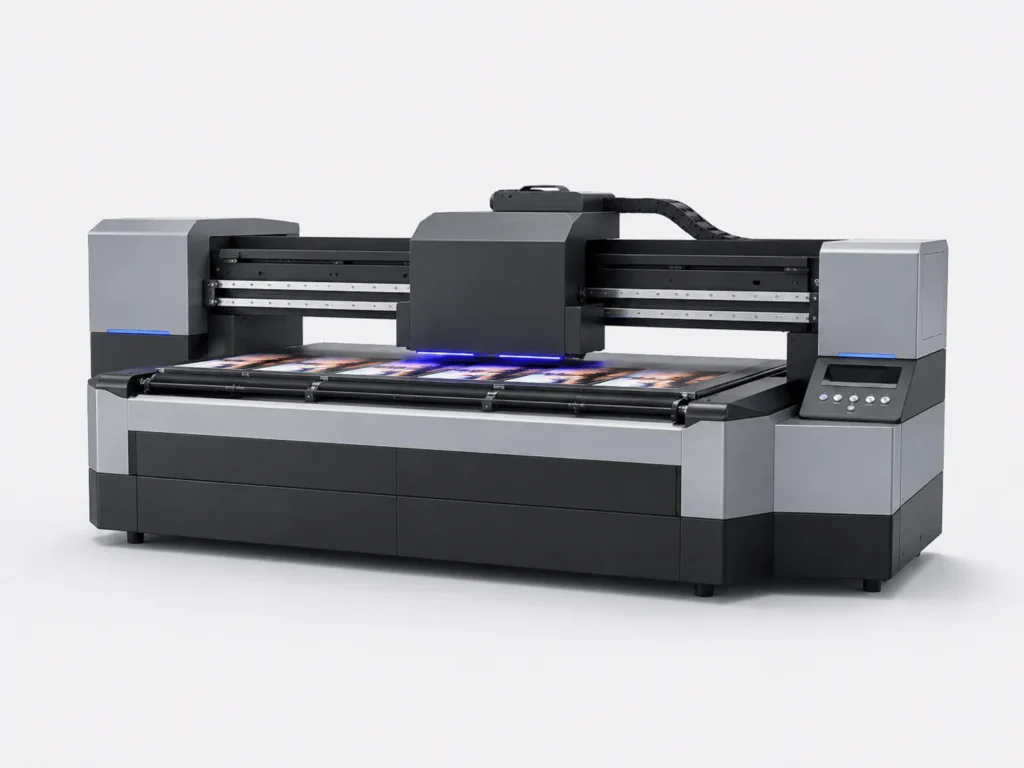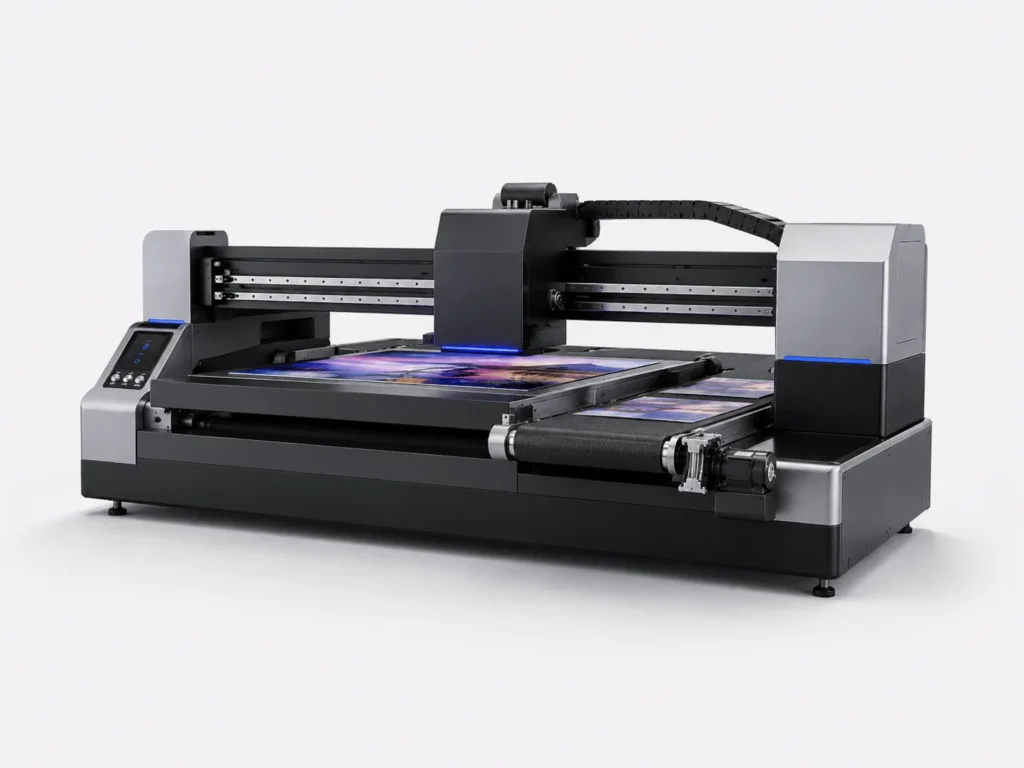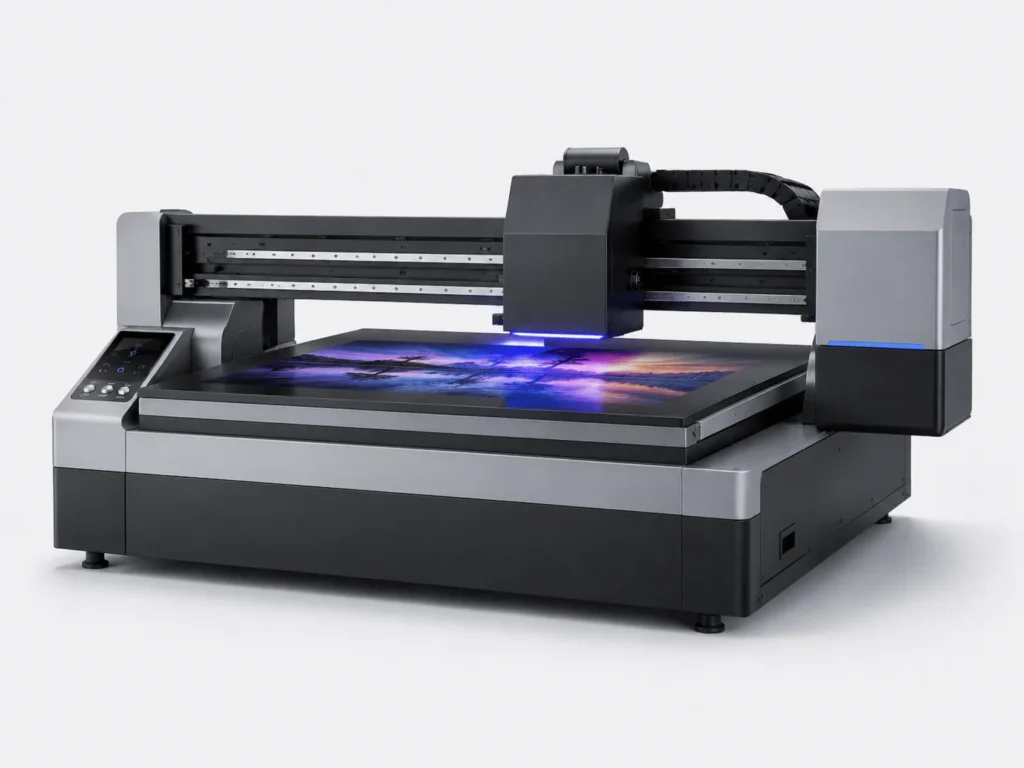
With the continuous growth of personalized customization and upgraded packaging demands, the way cylindrical products are decorated is changing significantly. Items such as tumblers, cosmetic bottles, and wine bottles are increasingly using direct printing instead of traditional labeling. As a result, 360-degree seamless printing has become a key focus in the industry, and the core equipment behind it is the cylindrical UV printer. Many people wonder why the design can wrap completely around the surface without any visible seam. In fact, this is the result of precise coordination between rotation control, inkjet synchronization, and software algorithms.
Basic Principle of 360° Cylindrical Printing
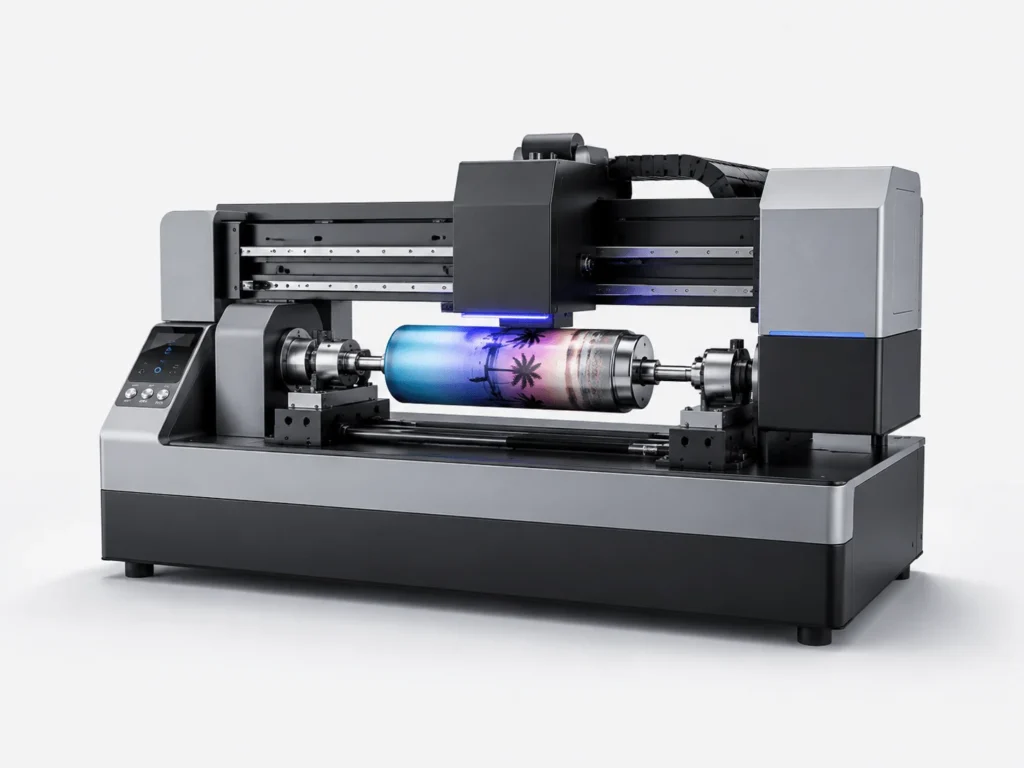
The core of 360° cylindrical printing is the coordinated process of “rotation + synchronized inkjet printing.” During printing, the product is fixed on a high-precision rotating shaft and spins at a stable and uniform speed, while the printhead moves horizontally to spray ink. The image is gradually built point by point on the cylindrical surface, forming a complete wraparound effect.
During the process, multiple systems must work in perfect coordination:
- The product rotates steadily and uniformly on the cylindrical UV printer
- The printhead outputs ink precisely based on image data
- The software calculates real-time rotation angle and image positioning
- UV curing lamps instantly dry and fix the ink
Through this continuous synchronization, the image can be accurately aligned on a curved surface, achieving a seamless visual effect.
Key Technical Components of 360° Printing
To ensure stable cylindrical printing, the equipment relies on multiple core modules working together, each of which directly affects print quality.
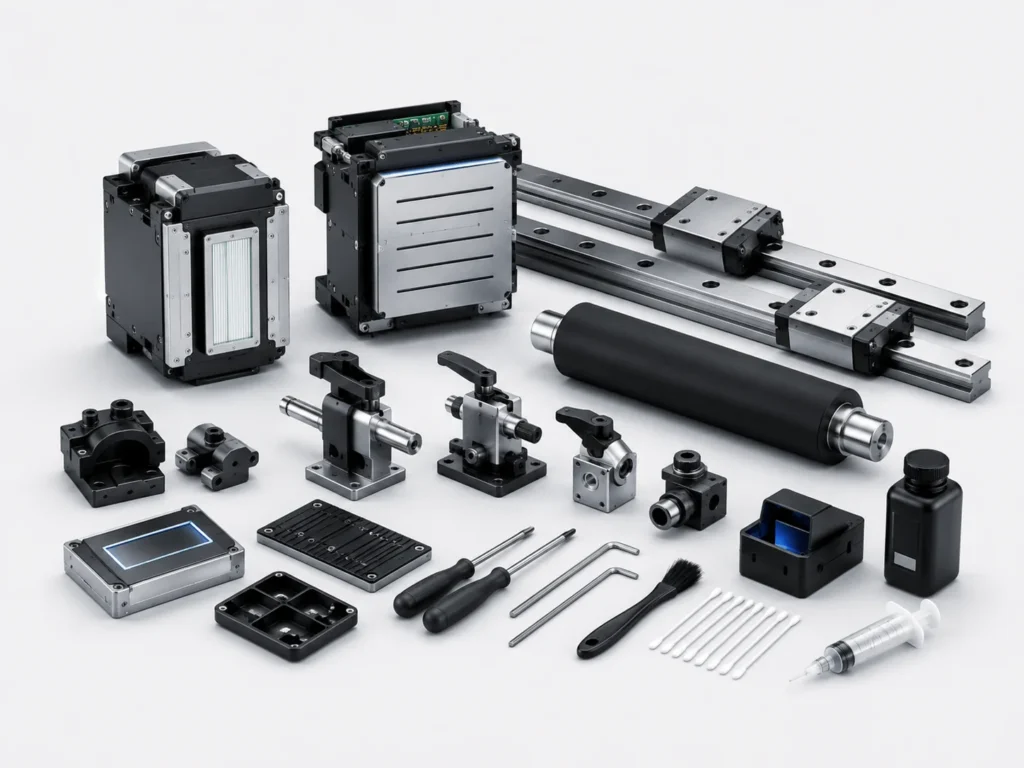
A high-precision rotation control system forms the foundation of the entire machine and determines printing stability. Cylindrical UV printers typically use servo motors to achieve extremely low-error continuous rotation, preventing image distortion or misalignment.
The printhead and guide rail system handle image output and movement control. The printhead performs high-density inkjet printing, while the guide rails ensure smooth and accurate movement. Both must remain perfectly synchronized to ensure precise alignment with the cylindrical surface. The system can also automatically adjust parameters to fit different product diameters.
The control system acts as the central coordinator. It calculates image mapping data, synchronizes rotation speed with inkjet frequency, and dynamically corrects minor deviations. At the same time, the UV curing module instantly dries the ink after printing, ensuring strong adhesion on various materials and preventing smudging.
Technical Challenges in 360° Cylindrical Printing
In real-world applications, 360° cylindrical printing requires extremely high precision, and several technical challenges must be addressed.
- Rotation speed and inkjet frequency must be perfectly synchronized to avoid stretching or compression of the image
- Cylindrical surfaces require image unwrapping and mapping calculations before printing to prevent misalignment
- Different materials have varying ink adhesion properties, requiring precise adjustment of curing intensity
- Long-term continuous production may introduce minor deviations, so automatic calibration systems are necessary
These factors collectively determine printing stability and highlight the precision value of cylindrical UV printers.
Practical Value of 360° Cylindrical Printing
As personalized consumption continues to expand, 360° printing technology is becoming widely adopted across multiple industries and is emerging as a key method for enhancing product value.
- Fully wrapped designs with no visible seams
- Supports small-batch and customized production
- Enhances product appearance and brand recognition
- Compatible with glass, metal, plastic, and other cylindrical materials
- More efficient production process compared to traditional labeling
In gift customization, cosmetic packaging, and cross-border e-commerce, this technology has become an important production solution. Cylindrical UV printers can directly print designs onto product surfaces without the need for labels or plates, significantly simplifying the workflow.
The realization of 360° cylindrical printing is essentially the result of deep integration between mechanical precision and digital control systems. Through the coordination of rotation mechanisms, inkjet control, and software algorithms, cylindrical surfaces achieve seamless image coverage. This technology not only transforms traditional manufacturing methods but also creates new opportunities for the customization market. SpringYprinter specializes in cylindrical UV printer solutions, providing stable and efficient equipment for 360° printing applications.