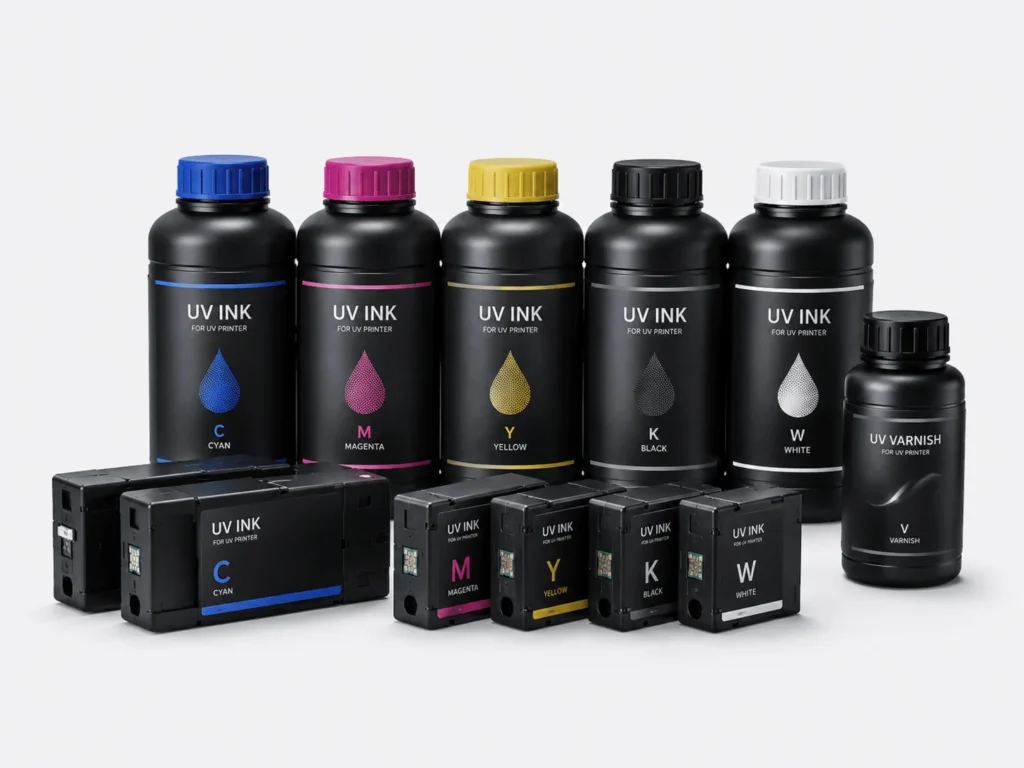
One of the key differences between UV printing and traditional inkjet printing is that UV ink does not dry through water or solvent evaporation. Instead, it undergoes a chemical reaction triggered by ultraviolet light, rapidly forming a solid ink film. This process directly affects print clarity, adhesion, abrasion resistance, and production efficiency. Understanding the curing principle of UV ink helps determine whether the equipment, ink, and UV system are properly matched, and also supports better control of print quality.
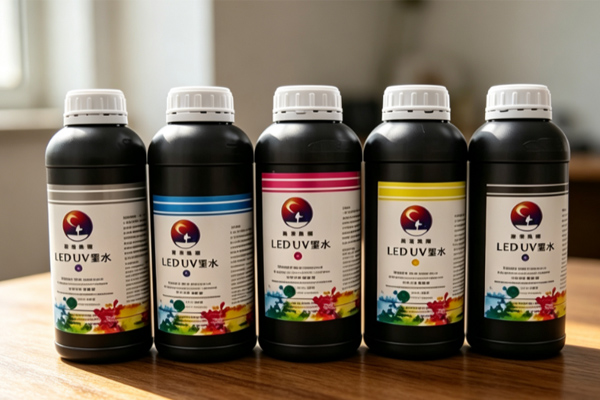
Why Can UV Ink Cure So Quickly?
Before discussing the specific reaction mechanism, it is important to understand the essence of UV curing: it is a “light-triggered rapid polymerization process.”
Photoinitiators Are the Key to the Curing Reaction
In UV ink systems, photoinitiators are the core component that enables fast curing.
- UV ink consists of monomers, oligomers, pigments, photoinitiators, and additives.
- After ink droplets are jetted onto the material surface, UV light begins to irradiate the ink layer.
- Photoinitiators absorb ultraviolet light and generate reactive species.
- These reactive species initiate crosslinking between monomers and oligomers.
- A stable three-dimensional polymer network is eventually formed.
This process belongs to photopolymerization and does not rely on natural evaporation. The ink rapidly transforms from liquid to solid, allowing printed products to proceed quickly to subsequent processing stages, making it suitable for high-efficiency production environments.
UV Light Source Determines Curing Efficiency
The stability of the energy source directly affects curing speed and quality.
- Common industrial light sources include mercury lamps and UV LED systems.
- Different light sources vary in wavelength, energy output, and thermal impact.
- UV LED features concentrated wavelength, fast response, and low energy consumption.
- The light source must match the ink formulation to achieve optimal performance.
- Production conditions must consider printing speed, ink layer thickness, and material properties.
Curing performance depends not only on light intensity but also on overall system compatibility.
How Does UV Ink Cure on Material Surfaces?
From droplet landing to film formation, UV ink undergoes a continuous process of “spreading – pinning – crosslink curing.”
Ink Droplet Landing and Initial Pinning
After reaching the material surface, the ink experiences a brief stage of flow and stabilization.
- The printhead jets CMYK ink, white ink, or varnish according to image data.
- Ink droplets slightly spread upon impact.
- Surface energy of the material influences droplet shape.
- Some systems apply weak UV exposure for pinning.
- This reduces droplet spreading and color mixing.
This stage focuses on stabilizing droplet edges, especially important for high-precision graphics and small text printing.
Complete Curing and Stable Film Formation
After initial pinning, UV light continues to supply energy, allowing the reaction to proceed further. Continuous UV exposure promotes deeper crosslinking, gradually transforming the ink layer from liquid into a solid polymer film. As the degree of crosslinking increases, hardness and abrasion resistance also improve. However, surface dryness does not necessarily indicate full curing. If internal curing is insufficient, adhesion and durability may still be affected. Complete curing requires attention to both surface and internal reaction levels.
What Factors Affect UV Ink Curing Performance?
Curing quality is determined by the combined influence of ink, light source, and material.
Ink and UV Light Source Must Be Matched
In actual production, the following matching factors are critical:
- Different ink systems require specific photoinitiator wavelength ranges.
- UV LED wavelength must match the ink absorption spectrum.
- Light intensity must be kept within a proper range.
- Excessive printing speed may lead to insufficient energy.
- Thick ink layers increase curing difficulty.
- White ink and varnish typically require higher energy.
When the system is well matched, output quality becomes more stable.
Material Surface Also Affects Performance
Material conditions directly influence curing results. Different substrates such as glass, acrylic, PVC, metal, and wood vary in surface energy and roughness. Dust or oil contamination reduces adhesion. Some low-surface-energy materials require pretreatment to achieve stable results, and the use of specialized inks can improve compatibility. The more stable the material condition, the more controllable the curing performance.
How to Achieve More Stable UV Printing Curing?
Stability depends on parameter control and process monitoring.
Proper Equipment Parameter Settings
In production practice, UV curing can be optimized through the following methods:
- Adjust the relationship between printing speed and UV energy.
- Optimize curing intensity based on ink layer thickness.
- Regularly check UV LED degradation.
- Keep lamp covers clean.
- Test white ink, color ink, and varnish separately.
Standardized parameter management reduces batch variation.
Use Practical Testing to Evaluate Curing Quality
In production, UV ink curing quality can be evaluated through the following tests:
- Check adhesion and scratch resistance.
- Observe whether surface tackiness remains.
- Evaluate color stability and detail reproduction.
- Establish testing standards for different materials.
- Conduct sample validation before mass production.
Systematic testing helps identify issues early and optimize processes.
UV printing achieves instant forming because UV light triggers photopolymerization, rapidly converting ink from a fluid state into a stable solid. To achieve ideal curing results, the ink system, UV light source, equipment parameters, and material surface conditions must work in coordination. Springyprinter focuses on industrial digital printing equipment development and provides stable and reliable UV printing and curing system solutions for enterprises.